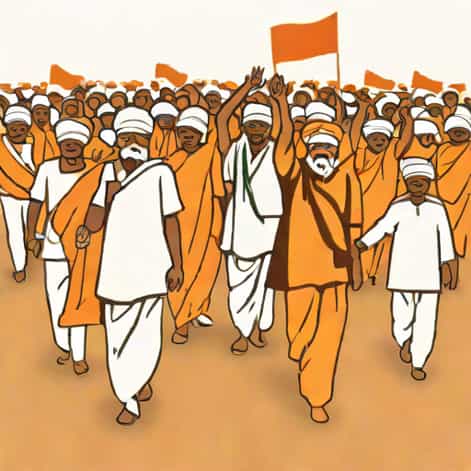
The Quit India Movement, one of the most significant movements in India’s struggle for independence, was undertaken in August 1942, during a period of global turmoil caused by World War II. India had been under British colonial rule for nearly two centuries, and the demand for complete independence had been steadily growing. The movement was a direct call to the British authorities to leave India immediately, reflecting the frustration and impatience of Indian leaders and the general populace with colonial exploitation, economic hardship, and political suppression. Understanding why the Quit India Movement was undertaken requires examining the historical context, political circumstances, and leadership strategies of the Indian independence movement at that time.
Historical Context Leading to the Quit India Movement
By the early 1940s, India had already witnessed decades of struggle against British rule, including movements like the Non-Cooperation Movement, the Civil Disobedience Movement, and the Salt March led by Mahatma Gandhi. Despite these efforts, the British government maintained control over India, and progress toward independence was slow. The outbreak of World War II in 1939 intensified India’s political and economic challenges, as the British unilaterally involved India in the war without consulting Indian leaders. This decision fueled widespread resentment and created a sense of urgency among Indian nationalists to demand immediate independence.
Impact of World War II
World War II placed enormous demands on India’s resources. The British government imposed heavy taxes, requisitioned goods, and exploited Indian labor and finances to support the war effort. These measures caused widespread hardship among the Indian population, including food shortages, inflation, and unemployment. Additionally, the British military recruitment of Indian soldiers without adequate representation or autonomy further intensified nationalist anger. The Quit India Movement was therefore partially a response to the economic exploitation and political marginalization caused by wartime policies.
-
Unilateral involvement of India in the war without consultation caused political outrage.
-
Economic exploitation during the war led to widespread public discontent.
-
Requisition of resources and labor contributed to social and economic instability.
Political Circumstances and Frustration with British Rule
By 1942, the Indian National Congress, under the leadership of Mahatma Gandhi, had grown increasingly frustrated with the slow pace of constitutional reforms and the British reluctance to grant independence. Previous efforts, including negotiations and petitions, had yielded little progress. The failure of the Cripps Mission, sent by the British government to secure Indian cooperation during World War II by promising post-war reforms, was a turning point. Indian leaders saw the mission as insincere and insufficient, which strengthened the demand for immediate and unconditional British withdrawal from India.
The Role of the Indian National Congress
The Indian National Congress was at the forefront of mobilizing public support for the Quit India Movement. Gandhi’s leadership emphasized nonviolent civil disobedience as a tool to challenge British authority while demonstrating the moral and political strength of Indian society. The Congress believed that mass mobilization, coupled with disciplined resistance, would make continued British rule untenable. The movement also aimed to unify diverse groups across India, including students, workers, peasants, and political activists, to collectively demand independence.
-
Congress leadership emphasized nonviolent resistance to gain moral high ground.
-
Mass mobilization aimed to involve all sections of society in the independence struggle.
-
Unification of diverse groups strengthened the political impact of the movement.
Immediate Objectives of the Quit India Movement
The primary objective of the Quit India Movement was to demand an immediate end to British rule in India. Leaders like Gandhi issued the famous Do or Die call, encouraging Indians to engage in peaceful protest and non-cooperation. The movement sought to paralyze the administrative machinery of the British government, demonstrating that the Indian population was united in its demand for sovereignty. This strategy was intended to pressure the British into conceding to the demands of the Indian people without resorting to violent revolution.
Strategies Employed During the Movement
The Quit India Movement relied on mass protests, strikes, boycotts, and acts of civil disobedience. While Gandhi emphasized nonviolence, localized violence and uprisings did occur in some regions due to frustration and spontaneous action. The British responded with mass arrests, censorship, and repression, including detaining top Congress leaders for several years. Despite these challenges, the movement demonstrated the organizational strength of Indian society and the determination of its leaders.
-
Mass protests and strikes disrupted British administration.
-
Boycotts of British goods and institutions signaled economic and political resistance.
-
Nonviolent civil disobedience highlighted the moral authority of Indian leaders.
Social and Economic Factors Driving the Movement
Economic distress and social grievances also played a significant role in prompting the Quit India Movement. Famine conditions in Bengal, rising unemployment, and inflation worsened public dissatisfaction. Rural populations, laborers, and students joined the movement as they experienced firsthand the impact of British economic policies. The movement thus became not only a political struggle but also a social expression of widespread frustration with colonial exploitation and injustice.
Role of Ordinary Citizens
Ordinary citizens, including peasants, workers, students, and women, played a crucial role in sustaining the Quit India Movement. Grassroots activism, including picketing, organizing rallies, and spreading awareness, helped create a mass movement that transcended social and regional divides. This broad participation underscored the national character of the movement and its significance as a turning point in India’s fight for independence.
-
Peasants and laborers contributed through strikes and protests.
-
Students and intellectuals spread awareness and mobilized communities.
-
Women played active roles in demonstrations and relief efforts.
Impact and Significance of the Quit India Movement
The Quit India Movement had profound effects on India’s independence struggle. Although the British did not immediately leave India, the movement demonstrated the growing unity and resolve of the Indian population. It weakened British authority, exposed the limitations of colonial governance, and strengthened the Indian National Congress as the central leadership of the independence movement. The movement also inspired future acts of resistance and highlighted the effectiveness of mass mobilization and civil disobedience as tools for political change.
Legacy of the Movement
The legacy of the Quit India Movement is enduring. It reinforced the principle that sustained, organized, and principled resistance could challenge colonial rule. It also emphasized the role of ordinary citizens in shaping national destiny, proving that independence was achievable through collective effort and moral courage. The movement remains a symbol of India’s determination to achieve sovereignty and justice.
-
Demonstrated the power of mass mobilization in achieving political goals.
-
Exposed the vulnerability of colonial authorities under unified opposition.
-
Strengthened the position of Indian leadership in the global struggle for independence.
The Quit India Movement was undertaken as a decisive response to decades of British colonial oppression, wartime exploitation, and political stagnation. It represented a culmination of historical grievances, economic hardships, and social frustrations, as well as a strategic push by the Indian National Congress to achieve immediate independence. By mobilizing millions of Indians across the country, the movement underscored the power of unity, nonviolent resistance, and collective action. Although the British did not immediately leave India, the Quit India Movement significantly advanced the cause of independence, inspiring future generations and leaving an enduring mark on the history of India’s struggle for freedom.