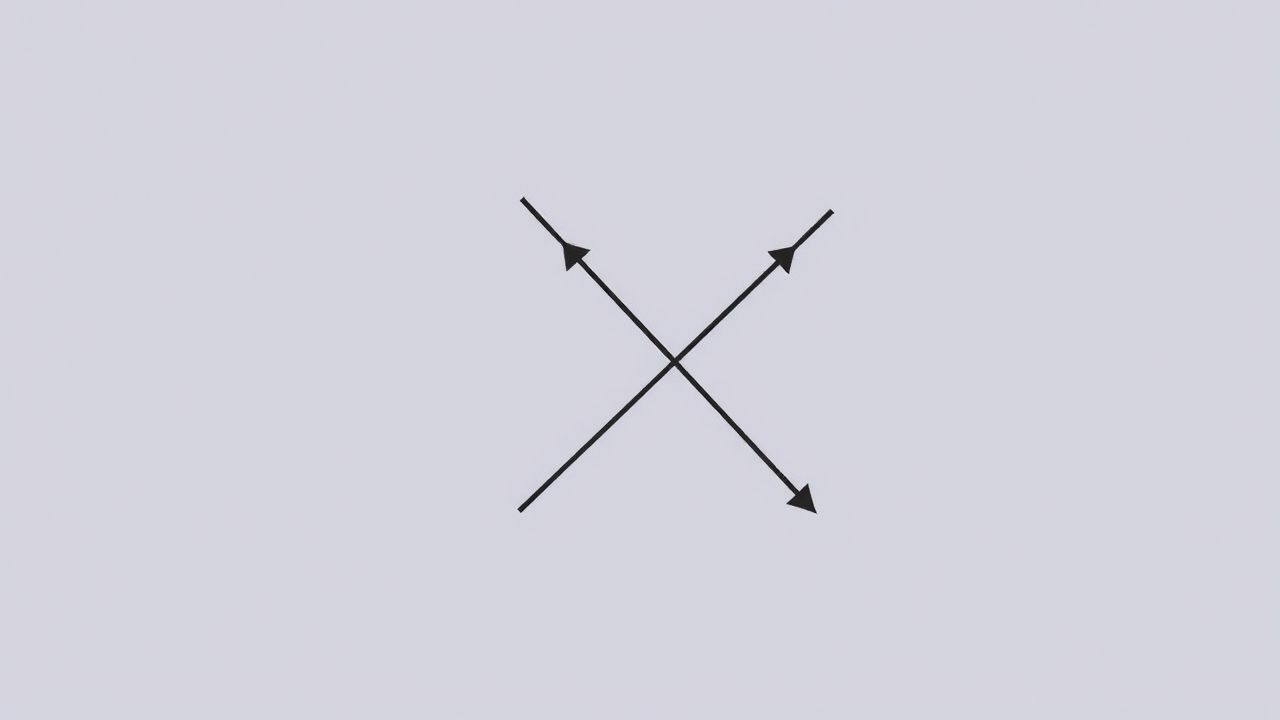
In coordinate geometry, understanding the relationship between the slopes of different lines is crucial for solving problems and interpreting graphs. One particularly important relationship involves perpendicular lines. Knowing how the slopes of perpendicular lines are related can help you determine if two lines intersect at a right angle, find equations of lines, and solve real-world problems involving geometry and spatial reasoning. This concept is not only used in academic math problems but also in engineering, architecture, and computer graphics.
Understanding Slopes in Geometry
The slope of a line represents how steep the line is and is usually denoted by the letterm. In a coordinate plane, slope is calculated as the change in the y-values divided by the change in the x-values between two points on the line. The slope formula is
m = (yâ â yâ) / (xâ â xâ)
This value can be positive, negative, zero, or undefined, depending on the direction of the line.
Types of Slopes
- Positive slopeThe line rises from left to right.
- Negative slopeThe line falls from left to right.
- Zero slopeThe line is perfectly horizontal.
- Undefined slopeThe line is perfectly vertical.
Defining Perpendicular Lines
Two lines are perpendicular if they meet at a right angle (90 degrees). In the coordinate plane, this right-angle intersection has a special property their slopes are related in a very specific way. This relationship holds for all lines except vertical and horizontal lines, which require special attention.
The Relationship Between Their Slopes
For non-vertical, non-horizontal lines, the slopes of perpendicular lines are negative reciprocals of each other. This means that if one line has slopem, the other line has slopeâ1/m.
Mathematically, if two lines are perpendicular, the product of their slopes equals â1
mâ Ã mâ = â1
Examples of Perpendicular Slopes
- If one line has a slope of 2, a perpendicular line will have a slope of â1/2.
- If one line has a slope of â3, a perpendicular line will have a slope of 1/3.
- If one line is horizontal (slope 0), the perpendicular line is vertical (undefined slope).
- If one line is vertical, the perpendicular line is horizontal.
Special Case Vertical and Horizontal Lines
A vertical line has an undefined slope because its change in x is zero, which makes the slope formula division by zero. A horizontal line has a slope of zero because there is no change in y. These two types of lines are always perpendicular to each other.
Finding the Equation of a Perpendicular Line
Suppose you are given the equation of a line and a point through which the perpendicular line must pass. To find the perpendicular line’s equation, follow these steps
- Find the slope of the given line.
- Take the negative reciprocal of that slope to get the perpendicular slope.
- Use the point-slope form of a liney â yâ = m(x â xâ).
- Simplify to slope-intercept form if necessary.
Example Problem
Given the line y = 2x + 1 and a point (4, 3), find the perpendicular line’s equation.
- The given slope is 2.
- The perpendicular slope is â1/2.
- Using point-slope form y â 3 = â1/2(x â 4).
- Simplifying y â 3 = â1/2x + 2 â y = â1/2x + 5.
The perpendicular line’s equation is y = â1/2x + 5.
Why Negative Reciprocals Work
This relationship comes from the geometric definition of perpendicularity. When two lines meet at a right angle, the change in their directions is such that the slopes multiply to â1. This property can be proven using trigonometric functions and the tangent of the angles that the lines make with the x-axis.
Proof Idea
If θ is the angle a line makes with the x-axis, its slope is tan(θ). A line perpendicular to it will make an angle θ + 90°, and tan(θ + 90°) = â1 / tan(θ). This shows mathematically why the slopes must be negative reciprocals.
Applications of Perpendicular Slopes
The concept of perpendicular slopes is used in many real-life and academic applications
- Architecture and designEnsuring walls, floors, and beams meet at right angles.
- EngineeringCalculating support angles for stability.
- Computer graphicsCreating perpendicular edges in shapes and models.
- NavigationPlotting routes that intersect at right angles.
Coordinate Geometry Problems
Many exam problems involve checking whether two lines are perpendicular. This is done by multiplying their slopes and checking if the product is â1. Alternatively, given two points for each line, you can calculate their slopes and apply the perpendicular condition.
Common Misunderstandings
- Thinking that perpendicular slopes are simply negatives of each other. For example, slopes 2 and â2 are not perpendicular because 2 Ã (â2) = â4, not â1.
- Forgetting that vertical and horizontal lines are perpendicular even though one has an undefined slope.
- Confusing perpendicular slopes with parallel slopes, which are equal, not negative reciprocals.
Another Example
Check if the lines 3x + 4y = 12 and 4x â 3y = 6 are perpendicular.
- Rewrite 3x + 4y = 12 as y = â3/4x + 3. Slope = â3/4.
- Rewrite 4x â 3y = 6 as y = 4/3x â 2. Slope = 4/3.
- Multiply slopes (â3/4) Ã (4/3) = â1.
- Since the product is â1, the lines are perpendicular.
Importance in Learning Geometry
Mastering the relationship between the slopes of perpendicular lines strengthens problem-solving skills in algebra, trigonometry, and geometry. It is a key concept that connects algebraic equations with geometric shapes. Recognizing negative reciprocal slopes can also make graphing and interpreting linear equations faster and more accurate.
The slopes of perpendicular lines are negative reciprocals of each other, and their product equals â1, except in cases involving vertical and horizontal lines. This relationship is a fundamental principle in coordinate geometry, making it easier to determine perpendicularity and solve related problems. Whether in mathematical proofs, design work, or practical construction, understanding perpendicular slopes ensures precision and accuracy in both theoretical and real-world applications.