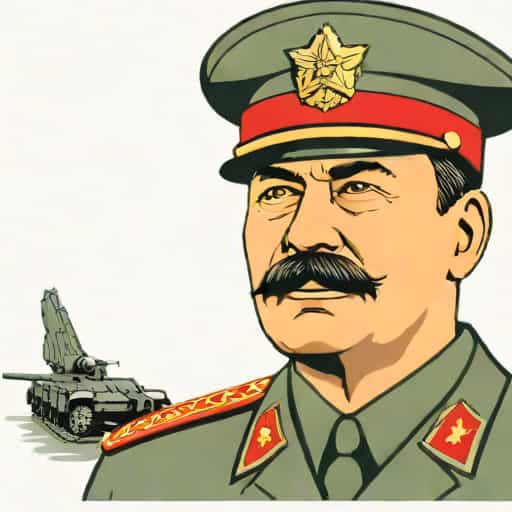
Joseph Stalin, the leader of the Soviet Union from the mid-1920s until his death in 1953, is widely recognized not only for his totalitarian rule but also for his militaristic policies and approach to both domestic and foreign affairs. Stalin’s reign was marked by an intense focus on strengthening the Soviet military, expanding the armed forces, and implementing strategies that emphasized war preparedness and aggressive defense measures. His militaristic tendencies were evident in multiple areas, including the rapid industrialization of the Soviet Union to support military production, the buildup of the Red Army, and his strategic involvement in conflicts that shaped global geopolitics. Understanding Stalin’s militaristic orientation is crucial for analyzing the Soviet Union’s behavior during his leadership and the broader historical context of 20th-century warfare.
Industrialization and Military Buildup
One of the clearest pieces of evidence of Stalin’s militarism was the extensive industrialization campaign known as the Five-Year Plans. While these plans were officially aimed at modernizing the Soviet economy, a significant portion of the resources and efforts was directed toward military production. Factories producing tanks, artillery, aircraft, and ammunition were prioritized, reflecting Stalin’s understanding that industrial strength was inseparable from military power. This militaristic focus ensured that the Soviet Union could rapidly mobilize resources for war, highlighting Stalin’s preparedness for both defensive and offensive operations.
Expansion of the Red Army
Stalin also demonstrated militaristic intent through the expansion and modernization of the Red Army. The army grew in both size and technological capability under his leadership. Compulsory military training, increased recruitment, and the development of specialized units were all part of a strategy to create a robust and disciplined fighting force. This buildup was not limited to personnel; significant investments were made in tanks, aircraft, and naval assets, indicating a deliberate effort to establish the Soviet Union as a formidable military power in anticipation of potential conflicts.
Foreign Policy and Strategic Aggression
Stalin’s militarism was not confined to domestic policies. His approach to foreign relations often reflected a strategic, militaristic mindset. The Soviet Union under Stalin engaged in actions that demonstrated a willingness to use military power or the threat of force to achieve political objectives. For instance, the annexation of territories such as the Baltic states and parts of Eastern Europe during World War II was carried out with careful military planning. Stalin’s negotiation tactics with Germany prior to Operation Barbarossa, including the Molotov-Ribbentrop Pact, also reflected a militaristic approach to diplomacy, using strategic positioning to buy time and strengthen the Soviet military.
World War II Strategies
During World War II, Stalin’s militaristic leadership was further evident. He played a central role in planning and directing the Soviet war effort against Nazi Germany. Despite initial setbacks, Stalin emphasized total mobilization, strict military discipline, and the use of harsh measures against perceived failures or deserters. His decisions, such as the defense of Stalingrad and the counter-offensive strategies leading to the eventual defeat of German forces, showcased both strategic planning and a reliance on military might to achieve political and territorial goals.
Military Purges and Control
Another aspect of Stalin’s militarism was his control over the military through purges and political oversight. In the late 1930s, Stalin conducted a series of purges that targeted high-ranking military officials, which, although destabilizing in the short term, ultimately reinforced his authority over the Red Army. By eliminating potential rivals and ensuring loyalty, Stalin demonstrated a militaristic approach that fused political control with military strategy. This concentration of power within the armed forces enabled him to implement large-scale military campaigns effectively and maintain strict command during times of war.
Emphasis on Military Education
Stalin also prioritized military education as part of his broader militaristic agenda. He encouraged the development of military academies and training programs designed to produce skilled officers and strategists. By investing in education and training, Stalin ensured that the Red Army was not only numerically strong but also tactically competent, reinforcing the militaristic orientation of his leadership. The emphasis on strategic thinking and preparedness underscored his belief in the centrality of military strength to Soviet security and global influence.
Propaganda and Militaristic Culture
Stalin used propaganda to foster a culture that glorified the military and reinforced the importance of national defense. Public campaigns celebrated military achievements, heroes, and patriotic duty, embedding a militaristic ethos into Soviet society. Films, posters, and literature depicted the Soviet military as the ultimate protector of the nation, creating public support for continuous military expansion and readiness. This propaganda not only strengthened Stalin’s political position but also reflected his belief that militarism was essential for maintaining power and ensuring national survival.
Weapons Development and Technological Advancements
The development of advanced weaponry under Stalin further evidences his militaristic orientation. The Soviet Union invested heavily in tanks, aircraft, and later nuclear technology, emphasizing innovation that could provide a strategic advantage. These investments demonstrated a forward-looking militarism that considered not only current threats but also future conflicts. Stalin’s focus on technological superiority in weaponry underlines a persistent commitment to military strength as a pillar of state policy.
Legacy of Stalin’s Militarism
Stalin’s militaristic policies left a lasting impact on the Soviet Union and global politics. The military structures, strategies, and industrial capacities he established played a critical role in the outcome of World War II and shaped the geopolitical landscape of the Cold War. His emphasis on military strength influenced Soviet doctrine for decades, ensuring that subsequent leaders continued to prioritize defense and military readiness. Evidence of Stalin’s militarism is thus visible not only in historical records and policies but also in the enduring military culture and capabilities of the Soviet Union long after his death.
multiple pieces of evidence indicate that Joseph Stalin was deeply militaristic in both domestic and foreign policies. From the industrialization efforts aimed at military production to the expansion and control of the Red Army, his leadership prioritized war preparedness and military dominance. His strategies during World War II, combined with purges, military education, propaganda, and technological investments, reinforce the view that Stalin viewed military power as essential to political control and national survival. Understanding this militaristic orientation is key to analyzing Stalin’s legacy and the broader history of the Soviet Union in the 20th century.