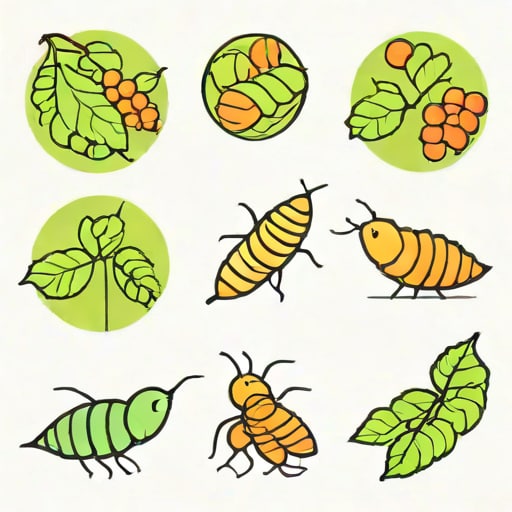
The silkworm is a fascinating insect that has been central to human culture and industry for thousands of years. Its ability to produce silk, one of the most luxurious and sought-after fibers, makes it a subject of study in biology, agriculture, and textile production. Understanding the life cycle of a silkworm is essential for sericulture, which is the cultivation of silkworms for silk. The life cycle is a remarkable process of transformation, consisting of several distinct stages egg, larva, pupa, and adult moth. Each stage has its own characteristics, behaviors, and requirements, and together they form a continuous cycle that repeats itself. Studying and drawing the life cycle of the silkworm helps students, farmers, and enthusiasts understand how silk is produced and how to care for these insects effectively.
Egg Stage of Silkworm
The life cycle of the silkworm begins with the egg stage. Female moths lay tiny eggs, often numbering in the hundreds, on mulberry leaves or specially prepared surfaces. These eggs are minuscule, measuring less than a millimeter in diameter, and have a hard protective covering that shields the developing embryo from environmental factors. The incubation period usually lasts about 10 to 14 days, depending on temperature and humidity. During this time, the egg develops into a larva, which is the next stage in the life cycle. Drawing the egg stage involves illustrating small, round shapes clustered together, often on a leaf surface, representing the careful placement by the female moth.
Key Characteristics of the Egg Stage
- Small and oval-shaped, often light yellow or cream in color.
- Protective covering to resist external environmental changes.
- Requires proper temperature and humidity to develop properly.
- Duration is approximately 10 to 14 days before hatching.
Larva Stage (Caterpillar)
After hatching from the egg, the silkworm enters the larva stage, also known as the caterpillar stage. This is the most active and feeding-intensive period of the life cycle. Silkworms are voracious eaters, consuming large quantities of mulberry leaves to grow rapidly. During this stage, the larva undergoes several molts, shedding its skin multiple times to accommodate its increasing size. The larva can reach a length of about 7 to 10 centimeters and becomes plump and creamy-white in appearance. This stage typically lasts 20 to 30 days, during which the silkworm stores energy necessary for the next stage of transformation. When drawing the larva stage, it is important to depict a segmented, elongated body with a smooth surface and small head, often shown crawling on a mulberry leaf.
Key Characteristics of the Larva Stage
- Soft-bodied, segmented, and elongated caterpillar.
- Feeding primarily on mulberry leaves to store energy.
- Goes through 4 to 5 molts to accommodate growth.
- Duration is about 20 to 30 days before entering the pupal stage.
Pupa Stage (Cocoon Formation)
Once the larva has grown sufficiently, it begins the pupal stage, which involves spinning a cocoon. The silkworm produces silk from its salivary glands and creates a protective covering around itself in a continuous, delicate thread. The cocoon provides a safe environment for the larva to transform into a moth. Inside the cocoon, the larva develops into a pupa, undergoing significant changes as its body reorganizes into an adult form. This stage is less active, as the pupa does not feed or move externally. Drawing the pupa stage usually involves showing the cocoon as a compact, oval structure, sometimes with the pupa slightly visible inside through the thin silk layers.
Key Characteristics of the Pupa Stage
- Cocoon is made of continuous silk thread, often white or yellowish.
- Pupa undergoes metamorphosis to develop into an adult moth.
- Stage is mostly inactive externally but highly active internally.
- Duration varies but typically lasts 10 to 14 days.
Adult Moth Stage
The final stage of the silkworm life cycle is the adult moth. Once metamorphosis is complete, the moth emerges from the cocoon by secreting an enzyme that softens the silk. The adult moth’s main purpose is reproduction. Female moths release pheromones to attract male moths, after which mating occurs. After laying eggs, the adult moths usually die within a few days, completing the life cycle. When drawing the adult moth stage, it is important to illustrate wings, antennae, and the body in a resting position, often near mulberry leaves or the previously formed cocoon.
Key Characteristics of the Adult Moth Stage
- Wings are pale, creamy-white, and covered with fine scales.
- Primary function is reproduction; adults do not feed.
- Females lay hundreds of eggs, continuing the life cycle.
- Life span is short, generally a few days after emergence.
Drawing the Complete Life Cycle
When drawing the life cycle of a silkworm, it is helpful to depict all four stages in a circular or linear progression to illustrate continuity. Each stage can be represented with accurate shapes, textures, and relevant features such as mulberry leaves for the larva, the silk cocoon for the pupa, and wings for the adult moth. Arrows are often used to indicate progression from one stage to the next, emphasizing the cyclical nature of the silkworm’s development. Labeling each stage clearly helps in understanding and learning the sequence, making the diagram educational and visually appealing.
Tips for Creating an Effective Diagram
- Use different colors to distinguish each stage clearly.
- Include labels such as Egg, Larva, Pupa, and Adult Moth.
- Draw arrows to show the direction of the life cycle progression.
- Include environmental elements like leaves, cocoon texture, and emerging moth features.
- Keep the proportions realistic to reflect the growth differences at each stage.
Importance of Understanding the Silkworm Life Cycle
Knowing the life cycle of silkworms is crucial for sericulture, biology education, and ecological studies. Farmers use this knowledge to optimize feeding, cocoon harvesting, and breeding practices. Students and researchers gain insights into insect development, metamorphosis, and silk production. By drawing and studying the life cycle, one can better understand the interconnected stages, timing, and transformations that make the silkworm a unique and valuable organism.
The life cycle of the silkworm is a remarkable journey from egg to adult moth, involving four distinct stages egg, larva, pupa, and adult. Each stage plays a critical role in the development of the insect and in silk production. Drawing the life cycle provides a visual representation that helps learners, farmers, and enthusiasts understand the transformation process. By including key characteristics, environmental context, and clear progression, one can create an accurate and educational depiction of this fascinating cycle. Understanding and illustrating the life cycle of silkworms not only supports learning and cultivation but also deepens appreciation for the complex biology behind one of the most important insects in human history.