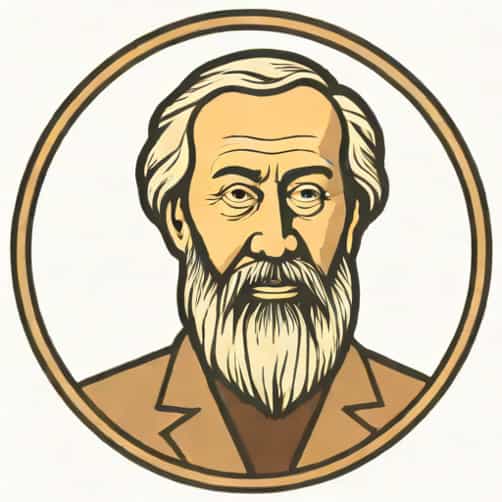
Alexander Solzhenitsyn is often remembered as a fierce critic of Soviet totalitarianism and the author of powerful works such asThe Gulag Archipelago. Yet behind his political and literary legacy lies a deeply personal question that continues to interest readers today did Alexander Solzhenitsyn believe in God? This question matters because faith, morality, and spiritual struggle appear repeatedly in his writings, speeches, and personal reflections. Understanding his religious beliefs helps readers better grasp his worldview, his critique of atheistic ideology, and the moral foundation of his literary voice.
Early Life and Religious Background
To understand Alexander Solzhenitsyn’s belief in God, it is important to look at his early life. He was born in 1918 in Kislovodsk, Russia, shortly after the Russian Revolution. His mother was a devout Russian Orthodox Christian, and she raised him with religious values, despite the increasingly hostile environment toward religion in Soviet society.
However, like many young people growing up in the Soviet Union, Solzhenitsyn gradually absorbed the official ideology of atheism. As a student, he excelled in mathematics and physics and embraced Marxist-Leninist ideas. During this period, his early faith faded, and he identified more with rationalism and state-sponsored atheism than with religious belief.
Loss of Faith and Embrace of Soviet Ideology
In his youth and early adulthood, Solzhenitsyn did not openly practice religion. He later admitted that he had abandoned belief in God during his university years. Like many intellectuals of his generation, he accepted the Soviet claim that religion was outdated and incompatible with scientific progress.
This phase of disbelief is important because it shows that Solzhenitsyn’s later faith was not inherited blindly or maintained without struggle. Instead, his belief in God emerged through personal suffering, reflection, and moral confrontation with evil. This transformation would become a central theme in his writing.
Imprisonment and Spiritual Transformation
The turning point in Alexander Solzhenitsyn’s belief in God came during his imprisonment in the Soviet labor camp system. Arrested in 1945 for criticizing Joseph Stalin in private letters, he was sentenced to eight years in labor camps, followed by internal exile.
Life in the gulag exposed Solzhenitsyn to extreme cruelty, injustice, and human degradation. At the same time, it forced him to confront fundamental questions about meaning, suffering, and morality. In his memoirs and essays, he later described how his time in the camps led him back to faith.
Solzhenitsyn wrote that it was through suffering that he rediscovered God. He came to believe that human beings cannot fully understand good and evil through ideology alone. Instead, he saw faith as essential to recognizing moral responsibility. This spiritual awakening was gradual, shaped by observation of fellow prisoners who maintained dignity and compassion despite unbearable conditions.
Christian Faith and Moral Philosophy
After his release, Solzhenitsyn increasingly identified as a Christian, specifically within the Russian Orthodox tradition. His belief in God was not abstract or purely philosophical. It was deeply moral and rooted in personal accountability.
One of his most famous ideas is that the line between good and evil runs through every human heart. This concept reflects a Christian understanding of sin and moral struggle. Rather than blaming systems alone, Solzhenitsyn emphasized individual responsibility, repentance, and spiritual growth.
His faith also shaped his rejection of materialism and atheism. He argued that societies built without belief in God inevitably lose moral direction. In his view, the Soviet Union’s crimes were not only political failures but also spiritual ones, caused by the denial of transcendent moral truth.
Religion in Solzhenitsyn’s Literary Works
Alexander Solzhenitsyn’s belief in God is clearly reflected in his literature. While his works are not religious sermons, they consistently explore spiritual themes such as redemption, conscience, and sacrifice.
-
The Gulag Archipelagoincludes reflections on prayer, humility, and spiritual awakening.
-
One Day in the Life of Ivan Denisovichportrays faith as a quiet source of strength rather than a political statement.
-
Cancer Wardexplores existential questions about death, meaning, and moral choice.
In these works, belief in God is not idealized or simplistic. Instead, it is shown as something tested by suffering and doubt. Solzhenitsyn presents faith as a hard-won truth, discovered through experience rather than imposed doctrine.
Public Statements About God and Faith
Later in life, Solzhenitsyn spoke openly about his belief in God. In essays, interviews, and speeches, he emphasized the importance of spiritual values in both personal and national life. One of his most well-known public moments was his 1978 Harvard Address, where he criticized Western materialism and moral decline.
In that speech, he argued that the West, like the Soviet Union, had lost something essential by moving away from faith. Although the political systems differed, he believed both were weakened by the absence of spiritual grounding. His criticism was not aimed at promoting a specific church, but at defending the necessity of belief in God for moral health.
Relationship With the Russian Orthodox Church
Solzhenitsyn’s relationship with the Russian Orthodox Church was respectful but independent. He valued Orthodox spirituality, tradition, and moral teaching, yet he was not uncritical of institutional religion. He believed that faith must remain sincere and personal, not merely cultural or political.
After returning to Russia in the 1990s, Solzhenitsyn supported a revival of spiritual life but warned against shallow nationalism or state-controlled religion. For him, belief in God was meaningful only when accompanied by humility, repentance, and moral courage.
Did Alexander Solzhenitsyn Truly Believe in God?
The evidence strongly suggests that Alexander Solzhenitsyn genuinely believed in God, especially in the second half of his life. His faith was not a temporary reaction or a rhetorical tool. It was the result of profound personal transformation shaped by suffering, reflection, and moral struggle.
Unlike some public figures, Solzhenitsyn did not use religion for popularity or power. His faith often placed him at odds with both Soviet authorities and Western intellectuals. This consistency strengthens the credibility of his belief.
Why His Faith Still Matters Today
Solzhenitsyn’s belief in God remains relevant in modern discussions about ideology, morality, and human dignity. His life suggests that faith can coexist with intellectual rigor and political courage. He challenged both atheistic authoritarianism and shallow consumerism, calling for a deeper understanding of human responsibility.
By asking whether Alexander Solzhenitsyn believed in God, readers are really asking a larger question about the role of faith in confronting evil and suffering. His answer, shaped by lived experience, was clear belief in God is not an escape from reality, but a way to face it honestly.