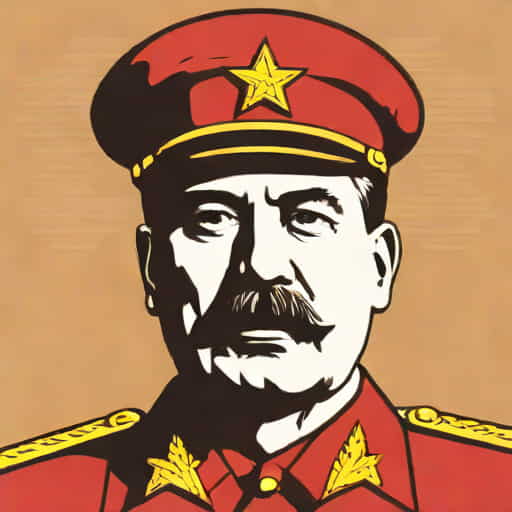
Joseph Stalin remains one of the most debated figures of the twentieth century, and understanding what he did requires looking closely at both his political actions and their impact on the Soviet Union and the world. Born in Georgia in 1878, Stalin rose from modest beginnings to become the leader of the Soviet Union after the death of Vladimir Lenin. His policies transformed the nation in ways that were both groundbreaking and devastating. While some view him as the architect of Soviet industrial power, others see him as responsible for mass repression, purges, and human suffering. To grasp the full scope of what Joseph Stalin did, one must consider his economic, political, and military strategies, as well as the darker side of his rule that left deep scars on history.
Rise to Power
Joseph Stalin maneuvered his way into leadership by consolidating power after Lenin’s death in 1924. At first, he was not considered the most prominent successor. However, Stalin used his position as General Secretary of the Communist Party to place loyal supporters in key roles, slowly sidelining his rivals. By the end of the 1920s, he had eliminated opposition figures such as Leon Trotsky, Grigory Zinoviev, and Lev Kamenev. This marked the beginning of his absolute dominance in Soviet politics.
Economic Policies and Industrialization
One of Stalin’s most defining actions was the push for rapid industrialization. Through a series of Five-Year Plans, beginning in 1928, he sought to transform the Soviet Union from a primarily agrarian economy into a global industrial power. This meant building factories, expanding heavy industries like coal, steel, and oil, and modernizing infrastructure. The results were dramatic the Soviet Union became capable of producing vast quantities of machinery, weapons, and other industrial goods.
Collectivization of Agriculture
Alongside industrialization, Stalin introduced collectivization, which meant consolidating small farms into large, state-run collective farms. This was meant to increase agricultural output and supply grain for urban workers. However, the policy caused massive disruptions. Millions of peasants resisted, leading to violent crackdowns. Famines broke out, most notably the Holodomor in Ukraine, where millions died of starvation. Collectivization became one of Stalin’s most infamous legacies, showing the high human cost of his economic ambitions.
Political Repression and the Great Purge
Another key part of what Joseph Stalin did was the establishment of a climate of fear through political repression. During the 1930s, Stalin orchestrated what became known as the Great Purge. This involved eliminating anyone seen as a threat to his authority, whether real or imagined. High-ranking military officials, party members, intellectuals, and even ordinary citizens were accused of treason, espionage, or anti-Soviet activities.
- Show trials were staged where accused individuals often confessed under torture or coercion.
- Millions were sent to labor camps, known as gulags, where harsh conditions led to countless deaths.
- The purges decimated the Red Army’s leadership, which would later impact the Soviet Union’s readiness for war.
This climate of terror ensured Stalin’s total control but at the cost of trust, stability, and human life.
World War II and Stalin’s Role
When World War II erupted, Stalin initially signed the Molotov-Ribbentrop Pact with Nazi Germany in 1939, a non-aggression treaty that allowed both powers to expand their territories. However, in 1941, Adolf Hitler launched Operation Barbarossa, invading the Soviet Union. Stalin was caught off guard, and the Soviet Union suffered catastrophic losses in the early stages of the invasion.
Despite these setbacks, Stalin rallied the nation. He centralized power, enforced discipline, and mobilized resources on a massive scale. Battles such as Stalingrad and Kursk became turning points in the war, with the Soviet Union playing a decisive role in defeating Nazi Germany. By 1945, Stalin had emerged as one of the victors of the war, his influence extended across Eastern Europe, shaping the postwar world order.
Postwar Policies and the Cold War
After the war, Stalin extended Soviet control over Eastern Europe. Countries such as Poland, East Germany, Czechoslovakia, and Hungary fell under communist regimes aligned with Moscow. This expansion marked the beginning of the Cold War, as tensions grew between the Soviet Union and the United States. Stalin’s policies created an ideological divide that defined global politics for decades.
Domestic Aftermath
Domestically, Stalin continued his rigid rule. The postwar years saw further industrial growth but also ongoing political repression. Citizens lived under strict censorship, surveillance, and fear of arrest. Intellectuals, artists, and even scientists were monitored and punished if their work strayed from state-approved ideology. Stalin maintained his grip on power until his death in 1953, leaving behind a nation both powerful and deeply scarred.
The Human Cost of Stalin’s Rule
One cannot fully explain what Joseph Stalin did without acknowledging the immense human cost of his leadership. Historians estimate that millions of people died due to forced collectivization, famines, purges, executions, and the gulag system. While Stalin transformed the Soviet Union into a superpower, the suffering endured by ordinary people remains a dark chapter in world history.
- Famines caused by collectivization resulted in widespread death.
- Forced labor camps imprisoned political opponents and ordinary citizens alike.
- Mass executions and purges destroyed entire communities and professions.
Stalin’s Legacy
The question of Stalin’s legacy is still contested. On one hand, he built the foundations of the Soviet Union as an industrial and military power, enabling it to play a central role in global affairs. On the other hand, his authoritarian rule, disregard for human life, and repressive policies left deep wounds. In Russia and former Soviet states, opinions on him remain divided-some still see him as a strong leader who defended the nation, while others remember him as a ruthless dictator.
When we ask what Joseph Stalin did, the answer spans multiple dimensions. He industrialized the Soviet Union, won a critical role in World War II, and established Soviet dominance in Eastern Europe. At the same time, his reign brought famine, fear, and death to millions. Stalin’s actions shaped not only the fate of his country but also the trajectory of the entire twentieth century. His legacy is both one of power and progress, and of repression and suffering-a duality that ensures Joseph Stalin’s name will continue to provoke debate for generations to come.