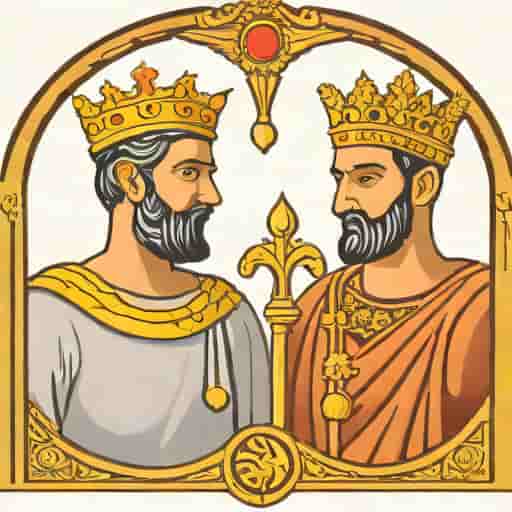
Constantine and Diocletian are two of the most influential emperors in Roman history, each leaving a profound impact on the political, social, and religious landscape of the Roman Empire. Diocletian is best known for his administrative reforms and the establishment of the Tetrarchy, which aimed to stabilize the empire during a time of internal turmoil. Constantine, on the other hand, is celebrated for his role in unifying the empire and for his pivotal support of Christianity, which transformed the religious foundation of Rome. Studying these two emperors provides insight into the evolution of imperial authority, the challenges of governing a vast empire, and the intersection of political power and religion. Their legacies continue to influence historical narratives and the understanding of leadership during a critical period in Roman history.
Diocletian Reformer and Stabilizer
Diocletian became Roman emperor in 284 CE, during a period of political instability, economic crisis, and external threats. The empire faced frequent usurpations, invasions, and a struggling economy that threatened its survival. Diocletian implemented comprehensive reforms to restore stability, strengthen imperial authority, and secure the borders. His approach combined military, administrative, and economic strategies, making him one of the most effective rulers of late antiquity.
The Tetrarchy
One of Diocletian’s most significant reforms was the establishment of the Tetrarchy in 293 CE, dividing the empire into four regions, each ruled by a co-emperor. Two senior emperors, called Augusti, and two junior emperors, called Caesars, were appointed to ensure smoother succession and more effective governance. This system was designed to address the problem of internal conflict and improve defense across the vast empire. While the Tetrarchy initially stabilized imperial rule, it ultimately proved difficult to maintain, as rivalries and ambitions among successors led to power struggles.
Administrative and Economic Reforms
Diocletian also reorganized provincial administration by increasing the number of provinces and creating dioceses, which helped improve tax collection and governance. To combat economic instability and rampant inflation, he issued the Edict on Maximum Prices, aiming to regulate wages and prices across the empire. Although enforcement proved challenging, this effort reflected his concern for economic stability. Diocletian’s reign strengthened the central authority of the emperor and laid the groundwork for administrative structures that endured for centuries.
Persecution of Christians
Another notable aspect of Diocletian’s rule was his persecution of Christians, particularly during the Great Persecution that began in 303 CE. Viewing Christianity as a threat to traditional Roman religion and imperial unity, Diocletian sought to enforce religious conformity through edicts demanding sacrifices to Roman gods. While the persecution was brutal, it ultimately failed to eradicate Christianity and set the stage for its later acceptance under Constantine.
Constantine Unifier and Christian Emperor
Constantine rose to prominence after the Tetrarchy system began to unravel, eventually becoming the sole ruler of the Roman Empire by 324 CE. Unlike Diocletian, Constantine is best remembered for his support of Christianity and his efforts to unify the empire under a single authority. His reign marked a turning point in Roman history, particularly in terms of religion, urban development, and imperial ideology.
Military Achievements and Consolidation of Power
Constantine’s path to power involved numerous military campaigns against rival emperors. His victory at the Battle of Milvian Bridge in 312 CE was particularly significant, as it secured his position in the Western Roman Empire. According to historical accounts, Constantine experienced a vision that led him to adopt the Christian cross as a symbol for his army, linking divine favor to his military success. By defeating Licinius in the east, he consolidated power, reuniting the empire under his rule and effectively ending the Tetrarchy.
Support of Christianity
One of Constantine’s most enduring legacies is his promotion of Christianity. He issued the Edict of Milan in 313 CE, granting religious tolerance to Christians and restoring confiscated property. Constantine also supported the construction of churches, patronized Christian leaders, and played a key role in convening the First Council of Nicaea in 325 CE to address theological disputes. His endorsement of Christianity transformed it from a persecuted religion to a state-supported faith, fundamentally reshaping the religious landscape of the Roman Empire.
Urban Development and Symbolic Acts
Constantine also contributed to the development of cities and imperial symbolism. He established Constantinople (modern-day Istanbul) as the new capital of the empire, strategically located for trade and defense. This city became a center of political power, culture, and Christianity for centuries. Constantine’s reign emphasized the divine authority of the emperor, blending political power with religious legitimacy, a concept that influenced subsequent rulers in Europe and beyond.
Comparing Diocletian and Constantine
While Diocletian and Constantine ruled in different contexts, their reigns share several similarities and differences that highlight the challenges and evolution of imperial rule in late antiquity.
Similarities
- Both implemented reforms to strengthen the empire and consolidate power.
- Each faced internal instability and external threats requiring strategic responses.
- They reorganized the administrative structure to improve governance and efficiency.
- Both left enduring legacies that influenced the Roman Empire and later European political structures.
Differences
- Diocletian focused on stabilizing a divided empire through the Tetrarchy, while Constantine aimed to unify the empire under a single ruler.
- Diocletian persecuted Christians to enforce traditional religious conformity; Constantine embraced Christianity and promoted it as a state-supported religion.
- Diocletian emphasized economic and administrative reforms, whereas Constantine focused on military victories, religious policy, and urban development.
- Diocletian abdicated voluntarily in 305 CE, an unusual move for Roman emperors, while Constantine ruled until his death, establishing dynastic continuity.
Legacy of Diocletian and Constantine
The legacies of Diocletian and Constantine continue to shape historical understanding of Roman governance, religious transformation, and imperial ideology. Diocletian’s reforms provided administrative stability and a model for bureaucratic governance, influencing the empire’s structure long after his abdication. Constantine’s support of Christianity fundamentally altered the religious identity of the empire, paving the way for the Byzantine Empire and the Christianization of Europe. Together, these emperors demonstrate how leadership, policy, and vision can have lasting impacts on society, culture, and religion, highlighting the interconnected nature of politics and belief systems in shaping history.
Influence on Later Empires
The administrative and religious innovations of Diocletian and Constantine set precedents for future empires. Bureaucratic governance, imperial symbolism, and the integration of religion with political authority became key elements in medieval European kingdoms and later Christian empires. Their legacies illustrate the importance of both practical governance and ideological influence in maintaining stability and authority over vast territories.
Diocletian and Constantine were transformative figures in Roman history, each addressing the unique challenges of their times through reforms, military strategy, and religious policy. Diocletian’s administrative genius and establishment of the Tetrarchy stabilized a fracturing empire, while Constantine’s military success and embrace of Christianity unified the empire and reshaped its spiritual and cultural foundation. Studying these two emperors provides valuable insights into leadership, governance, and the complex relationship between politics and religion. Their combined legacies demonstrate how vision, strategy, and decisiveness can leave a lasting imprint on history, influencing not only the Roman Empire but also the development of Western civilization for centuries to come.