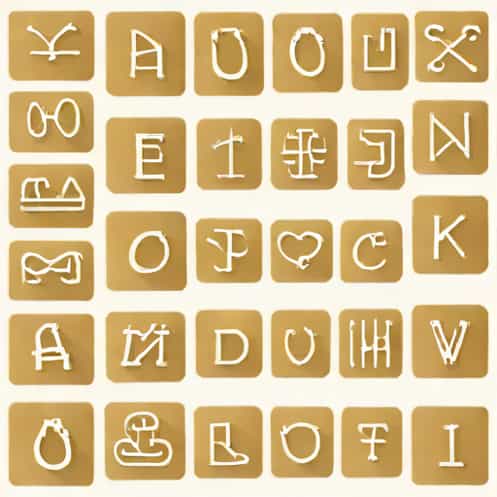
The Phoenician alphabet is one of the most significant writing systems in human history, representing a major leap in communication and literacy. Originating around 1050 BCE in the region of modern-day Lebanon, Syria, and northern Israel, the Phoenician alphabet was a revolutionary tool that simplified writing compared to complex pictographs and cuneiform used in earlier civilizations. It introduced a systematic way to represent sounds, laying the foundation for many modern alphabets. Understanding the Phoenician alphabet helps us trace the development of written language and highlights the ingenuity of ancient cultures in fostering trade, culture, and communication.
Origins of the Phoenician Alphabet
The Phoenician civilization was centered along the Mediterranean coast, thriving as merchants and sailors. This strategic location facilitated contact with various cultures, necessitating a practical system for record-keeping, communication, and trade. Prior to the Phoenician alphabet, writing systems were cumbersome, relying on hundreds of symbols. The Phoenicians simplified writing by using a set of consonantal letters, which represented distinct sounds. This system enabled faster writing and easier learning, which proved useful for trade, administration, and cultural exchange across the Mediterranean.
Structure and Characteristics
The Phoenician alphabet consisted of 22 letters, all representing consonants, and did not include vowels. Each letter had a specific name and shape, often derived from pictorial symbols representing objects, animals, or concepts. For example, the letter aleph represented an ox, while beth represented a house. The script was written from right to left, and each symbol was simple enough to be inscribed on stone, clay, or papyrus. Despite its simplicity, the system was highly efficient for the needs of the Phoenicians, particularly for trade and correspondence.
Significance in Trade and Communication
The Phoenician alphabet played a crucial role in the expansion of trade networks. Merchants used it to keep accounts, label goods, and communicate across diverse regions without needing to learn multiple writing systems. This alphabet spread along trade routes, influencing neighboring cultures such as the Greeks, who adapted it and added vowels to create the Greek alphabet. Over time, these adaptations led to the development of Latin, Hebrew, Arabic, and other modern writing systems. The Phoenician alphabet thus served as a bridge between ancient pictorial writing and modern alphabets.
Influence on Other Writing Systems
The Phoenician alphabet’s simplicity and adaptability made it highly influential. Greek scholars adopted it around the 8th century BCE, transforming the consonantal script into a system that included vowels. This innovation made reading and writing more precise and accessible. The Latin alphabet, which underpins most Western languages today, evolved directly from the Greek adaptation of the Phoenician script. Semitic languages, including Hebrew and Aramaic, also retain significant features of the Phoenician alphabet. The widespread adoption highlights its lasting impact and efficiency as a written communication system.
Development of Letter Names
Each Phoenician letter had a name that often related to everyday life or symbolic concepts. These names were mnemonic devices that helped people remember the letters and their associated sounds. For instance, gimel represented a camel, daleth a door, and resh a head. These associations made the script intuitive and facilitated learning, especially in societies where literacy was essential for commerce and administration. This feature influenced later alphabets, where letter names often retained symbolic or phonetic significance.
Writing Conventions and Usage
The Phoenician alphabet was primarily written without spaces between words, a practice common in ancient scripts. The text flowed continuously, requiring readers to infer word boundaries from context. Writing materials included stone inscriptions, metal plaques, and papyrus scrolls, demonstrating the versatility of the alphabet in various media. Inscriptions were used for official records, religious texts, commemorations, and commercial transactions. This versatility contributed to the alphabet’s rapid spread and enduring legacy.
Legacy of the Phoenician Alphabet
The Phoenician alphabet’s greatest legacy lies in its influence on later writing systems. By reducing writing to a manageable set of symbols representing sounds, it enabled wider literacy and facilitated cultural exchange. Ancient civilizations could communicate more effectively, preserve records, and pass down knowledge with greater accuracy. Its descendants, including Greek, Latin, Hebrew, and Arabic scripts, have shaped global literacy and written communication for thousands of years. Studying the Phoenician alphabet offers valuable insight into how human societies develop tools for communication and adapt them for long-term use.
Modern Recognition and Study
Archaeologists and linguists have studied Phoenician inscriptions extensively, uncovering evidence of its use in trade, religion, and governance. These studies provide context for the development of alphabets worldwide and illustrate the ingenuity of early civilizations. Modern recognition of the Phoenician alphabet emphasizes the continuity of human innovation in written communication. Many museums and historical collections preserve Phoenician artifacts, allowing people to explore the origins of letters and symbols that still influence contemporary writing systems.
Educational Importance
Learning about the Phoenician alphabet is valuable for students of history, linguistics, and archaeology. It provides a foundational understanding of how written language evolved and highlights the interconnectedness of ancient cultures. Educators use the Phoenician alphabet as a case study to demonstrate the evolution from pictographs to phonetic scripts, showing how innovation in writing facilitated trade, governance, and cultural exchange. Understanding this alphabet enhances appreciation for the complex development of human communication over millennia.
The Phoenician alphabet stands as a milestone in the history of written communication, representing a shift from complex symbols to a systematic phonetic script. Its 22 letters, right-to-left writing, and mnemonic letter names allowed for efficient record-keeping, trade, and communication. The alphabet influenced Greek, Latin, Hebrew, and Arabic scripts, forming the foundation of many modern alphabets. Studying the Phoenician alphabet provides insight into the ingenuity of ancient civilizations and their impact on human literacy and culture. Its legacy continues to shape how people around the world communicate, proving that even thousands of years ago, the Phoenicians created a tool with enduring significance for global civilization.