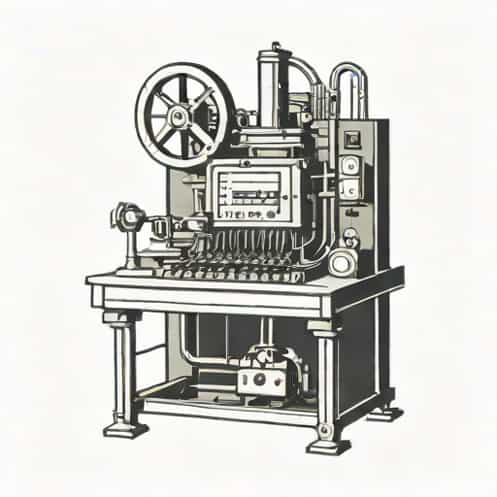
Herman Hollerith invented a machine called the punched card tabulating machine, which revolutionized the way data was processed in the late 19th and early 20th centuries. Before Hollerith’s invention, processing large amounts of statistical information was time-consuming and error-prone, often requiring teams of clerks to manually sort and count data. Hollerith’s machine automated much of this work, allowing information to be recorded on punched cards and read mechanically. This innovation laid the groundwork for modern computing and data processing systems, establishing Hollerith as a pivotal figure in the history of technology. In this topic, we will explore the life of Herman Hollerith, the invention of his tabulating machine, its applications, and its lasting impact on data management and computing.
The Life of Herman Hollerith
Herman Hollerith was born on February 29, 1860, in Buffalo, New York. He studied mechanical engineering and later became interested in statistics and data processing. His background in engineering and mathematics positioned him perfectly to address the challenges of processing large datasets, particularly in government and business applications. Hollerith recognized the limitations of manual data processing methods and sought to develop a mechanical solution that could increase efficiency, accuracy, and speed.
Early Career and Interests
Before inventing his tabulating machine, Hollerith worked for the United States Census Bureau, where he witnessed firsthand the difficulties of processing census data. The 1880 census had taken nearly a decade to compile and analyze due to the sheer volume of information. These experiences inspired Hollerith to design a system that could handle large-scale data processing more efficiently, ultimately leading to the creation of his punched card tabulating machine.
The Invention of the Punched Card Tabulating Machine
Herman Hollerith invented a machine called the punched card tabulating machine, which used electrically conductive contacts to read holes punched in cards representing data. Each punched card contained information encoded as a series of holes, with each hole corresponding to a specific piece of data, such as age, gender, occupation, or location. The machine would then count and sort these cards based on the data represented, producing accurate statistics much faster than manual methods.
How the Machine Worked
The tabulating machine consisted of several components designed to work together seamlessly
- Punched CardsCards with holes representing individual data points.
- Card ReaderA mechanical device that detected the presence or absence of holes using electrical contacts or mechanical pins.
- Counting MechanismA system that recorded and summed the data, often printing results on a paper tape or card.
- Sorting MechanismAllowed cards to be organized according to specific criteria, facilitating faster analysis.
By combining these components, Hollerith’s machine could process thousands of data points in a fraction of the time it took manual clerks. This innovation dramatically increased efficiency and accuracy, especially for large-scale governmental tasks like the census.
Applications of Hollerith’s Machine
Hollerith’s tabulating machine was first used extensively for the 1890 United States Census. The census, which previously required years to process, was completed in just a few months thanks to the efficiency of the punched card system. This success demonstrated the machine’s effectiveness and sparked interest in other applications of automated data processing.
Government and Census Applications
After the success of the 1890 census, government agencies quickly recognized the value of Hollerith’s invention. The machine was adopted for other large-scale data processing tasks, such as tax collection, population surveys, and military logistics. Its ability to handle vast amounts of data accurately and quickly made it an indispensable tool for bureaucratic and administrative functions.
Business and Industrial Applications
In addition to government use, businesses began to employ Hollerith’s machines for tasks such as inventory management, payroll processing, and customer record-keeping. The ability to organize and analyze large datasets efficiently gave companies a competitive advantage and marked the beginning of modern business data processing techniques.
The Birth of a Company and Legacy
Hollerith eventually founded the Tabulating Machine Company in 1896, which later merged with other companies to form the Computing-Tabulating-Recording Company (CTR). CTR would eventually become International Business Machines, or IBM, a global leader in computing technology. Hollerith’s pioneering work in data processing laid the foundation for modern computing, influencing subsequent generations of engineers, mathematicians, and computer scientists.
Impact on Modern Computing
Hollerith’s punched card system introduced the concept of encoding information in a machine-readable format, a principle that underpins modern computing. The tabulating machine demonstrated how automation could drastically improve efficiency, accuracy, and scalability in data management. Many early computers used punched card technology, directly inspired by Hollerith’s invention, bridging the gap between mechanical and electronic computing.
Recognition and Honors
Herman Hollerith is recognized as one of the pioneers of computing and data processing. His invention of the punched card tabulating machine earned him widespread acclaim during his lifetime and posthumously. Many historians credit Hollerith with transforming how societies handle information, influencing fields ranging from statistics to computer science.
Herman Hollerith invented a machine called the punched card tabulating machine, which transformed the way data was processed and laid the groundwork for modern computing. By automating the counting, sorting, and analysis of large datasets, Hollerith’s invention increased efficiency, reduced errors, and influenced both government and business practices. The success of his machine during the 1890 United States Census demonstrated its revolutionary potential, and the founding of his company ultimately contributed to the creation of IBM, a cornerstone of the computing industry. Hollerith’s legacy endures in the principles of data encoding, automation, and systematic information management, reminding us that innovation often emerges from the intersection of necessity, creativity, and technical skill.