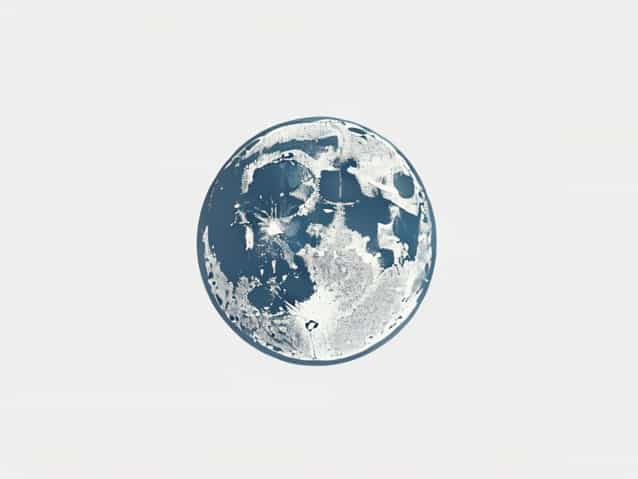
The Moon is Earth’s only natural satellite and has fascinated humans for centuries, inspiring myths, scientific inquiry, and space exploration. One of the fundamental questions people often ask about the Moon is its size, particularly its diameter. Understanding the Moon’s diameter is important not only for astronomy but also for space missions, gravitational studies, and understanding how it affects tides on Earth. The Moon is significantly smaller than Earth, yet it plays a crucial role in stabilizing our planet’s rotation and influencing natural phenomena. Knowing its diameter helps scientists estimate other physical properties such as volume, surface area, and gravitational pull, which are essential for both theoretical studies and practical applications in space science.
What is the Diameter of the Moon?
The diameter of the Moon is approximately 3,474 kilometers (2,159 miles). This measurement represents the distance from one point on the Moon’s surface, through its center, to the opposite side. To put this in perspective, the Moon’s diameter is roughly one-quarter of Earth’s diameter, which is about 12,742 kilometers. This difference in size contributes to the Moon’s lower gravitational force compared to Earth, approximately one-sixth of Earth’s gravity. The Moon’s smaller size and lower mass make it an ideal target for understanding the effects of reduced gravity on various physical and biological processes, which is why lunar exploration has been a key focus of space programs.
Measuring the Moon’s Diameter
Measuring the diameter of the Moon has been possible through a combination of historical observations and modern technology. Ancient astronomers used lunar eclipses and angular measurements to estimate the Moon’s size relative to Earth. Today, advanced methods allow for precise measurement
- Radar and Laser RangingBy bouncing radar waves or laser pulses off the Moon’s surface and measuring the time it takes for them to return, scientists can calculate the distance and diameter accurately.
- Satellite ImagingLunar orbiters, such as NASA’s Lunar Reconnaissance Orbiter, capture high-resolution images, which help map the Moon’s surface and determine its dimensions with precision.
- Astronomical ObservationsUsing telescopes and triangulation methods, astronomers can calculate the Moon’s diameter by analyzing its apparent size from Earth.
Comparison with Earth and Other Celestial Bodies
The Moon’s diameter of 3,474 kilometers makes it smaller than Earth but larger than many other moons in the solar system. For example, Jupiter’s moon Ganymede, the largest moon in the solar system, has a diameter of about 5,268 kilometers. Saturn’s moon Titan is slightly smaller, at 5,151 kilometers. Comparing the Moon’s size with Earth’s shows how its relatively modest size still has significant gravitational effects. Despite being smaller, the Moon exerts enough gravitational pull to create tides, stabilize Earth’s axial tilt, and influence long-term climate patterns. Its size also allows it to be visible from Earth as a distinct, luminous object in the night sky.
Impact of Diameter on Gravity and Surface Features
The Moon’s diameter directly affects its gravitational force, which is about 1.62 meters per second squared, compared to Earth’s 9.81 meters per second squared. This lower gravity allows astronauts to move more easily and enables the retention of a thinner layer of lunar soil and dust known as regolith. The diameter also affects the Moon’s geological features
- Smaller size means fewer internal heat sources, resulting in limited volcanic activity compared to Earth.
- The Moon’s large craters and basins are easier to preserve over time due to the lower gravity and absence of weathering processes.
- Its diameter and mass influence the formation of maria, which are vast basaltic plains formed by ancient volcanic eruptions.
Variations in Measurements
Although the Moon’s average diameter is 3,474 kilometers, measurements can vary slightly depending on whether the equatorial or polar diameter is considered. The Moon is not a perfect sphere but an oblate spheroid, meaning it is slightly flattened at the poles and bulging at the equator. The equatorial diameter is about 3,476 kilometers, while the polar diameter is slightly smaller, around 3,472 kilometers. This small difference does not drastically affect calculations of the Moon’s volume or gravity but is important for high-precision lunar missions and orbital mechanics.
Significance of Knowing the Moon’s Diameter
Understanding the Moon’s diameter has practical and scientific significance
- Space MissionsAccurate knowledge of the Moon’s size is crucial for planning lunar landings, orbital insertions, and rover explorations.
- Gravitational StudiesCalculations of lunar gravity depend on its diameter and mass, which affect Earth-Moon interactions.
- Tidal PredictionsThe Moon’s gravitational pull influences ocean tides, making diameter and mass data important for modeling tidal effects.
- Lunar MappingAccurate measurements allow scientists to map the Moon’s surface for scientific research and future colonization plans.
- Comparative PlanetologyStudying the Moon’s diameter and structure helps astronomers understand the formation and evolution of other celestial bodies in the solar system.
The Moon’s diameter, approximately 3,474 kilometers, is a fundamental measurement that provides insight into its physical properties, gravitational influence, and role in the Earth-Moon system. Its size, smaller than Earth but significant enough to affect tides, stabilize the planet’s tilt, and create a dynamic night sky, makes it a key object of study in astronomy and space exploration. Understanding the Moon’s diameter helps scientists plan missions, study gravity, and explore geological features, while also inspiring curiosity and wonder about our closest celestial neighbor. As technology advances, measurements of the Moon’s diameter and other properties continue to become more precise, deepening our understanding of the Moon and its impact on life on Earth.