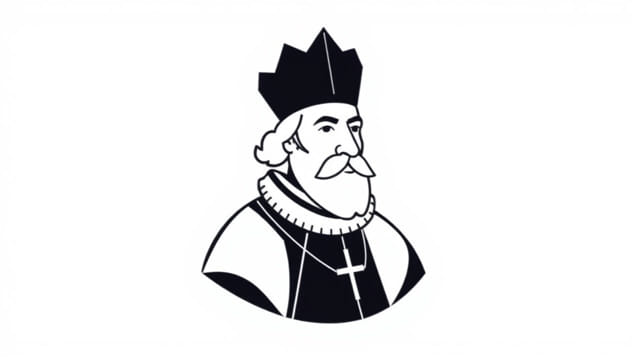
Cardinal Richelieu was one of the most influential political figures in 17th-century France, known for his sharp intellect, strategic mind, and ability to consolidate royal power under the monarchy. He played a central role in shaping modern France through his service as chief minister to King Louis XIII. Often remembered for his political ruthlessness and commitment to strengthening the authority of the French crown, Richelieu left an enduring legacy not only as a cardinal of the Catholic Church but as a master statesman whose actions helped define the structure of the modern French state.
Early Life and Ecclesiastical Career
Armand Jean du Plessis, who would later become known as Cardinal Richelieu, was born on September 9, 1585, in Paris, France. He came from a noble but not especially wealthy family. His father died when he was five, leaving the family in financial difficulty. Despite these early hardships, Richelieu pursued a religious education, attending the prestigious Collège de Navarre in Paris.
Originally intending to become a soldier, Richelieu changed course to enter the clergy so that he could inherit a bishopric that had been reserved for his family. In 1607, at just 22 years old, he was appointed Bishop of Luçon by Pope Paul V. His dedication and administrative skill quickly earned him attention, and he was recognized as a capable reformer aligned with the ideals of the Counter-Reformation.
Entry into French Politics
Richelieu’s entrance into national politics began when he became a representative in the Estates-General in 1614. His performance brought him into contact with powerful figures at court, including Queen Marie de’ Medici, the mother of King Louis XIII. In 1622, he was named a cardinal by Pope Gregory XV, and by 1624, he was appointed Chief Minister of France. This marked the beginning of Richelieu’s most influential period.
The Role of Chief Minister
As Chief Minister, Richelieu held vast power in France. He was determined to strengthen the monarchy and centralize authority under the crown, believing that a strong king was necessary for a strong nation. His major goals included weakening the power of the nobility, limiting the influence of the Huguenots (French Protestants), and curbing the autonomy of local governors and parlements.
Richelieu used all means available to achieve his ends, including espionage, censorship, and even execution of political opponents. He reorganized the administrative structure of France to ensure loyalty to the crown and developed a network of intendants royal agents who oversaw provinces and reported directly to the king, bypassing local power structures.
Conflict with the Huguenots
One of Richelieu’s first major political campaigns was against the Huguenots. Though the Edict of Nantes (1598) had granted them religious freedoms, many Huguenots had developed independent political and military power bases. Richelieu viewed this as a threat to the unity of France.
In 16271628, Richelieu led the military campaign against the Huguenot stronghold of La Rochelle, a port city aligned with England. After a brutal siege, the city surrendered, and Richelieu imposed strict terms. Although religious toleration remained, the Huguenots were stripped of their political and military privileges, further consolidating royal authority.
Foreign Policy and the Thirty Years’ War
Despite being a Catholic cardinal, Richelieu was willing to ally with Protestant powers in order to weaken the Habsburgs, the powerful Catholic dynasty that dominated both Spain and the Holy Roman Empire. He placed the interests of the French state above religious loyalty, a hallmark of his realist approach to diplomacy.
France entered the Thirty Years’ War directly in 1635. Richelieu’s foreign policy aimed at reducing Habsburg influence in Europe and securing France’s position as a dominant continental power. Although the war brought economic strain and social unrest, Richelieu’s strategic alliances helped advance France’s long-term geopolitical interests.
Opposition and Repression
Richelieu’s rise to power was not without resistance. Many nobles, resentful of his policies, plotted against him. The most famous was the Day of the Dupes in 1630, when Queen Marie de’ Medici tried to force King Louis XIII to dismiss him. However, Richelieu managed to secure the king’s support and emerged even stronger.
To suppress dissent, Richelieu used a wide range of tools. He established a secret police, cracked down on sedition, and did not hesitate to imprison or execute those who opposed him. While his methods were harsh, they were effective in consolidating the king’s power and reducing internal threats to the state.
Legacy and Death
Cardinal Richelieu died on December 4, 1642, just months before the death of Louis XIII. His final years were marked by continued political involvement and attempts to secure a lasting framework for centralized governance. On his deathbed, he recommended Cardinal Mazarin as his successor, ensuring continuity of his policies.
Richelieu’s legacy is complex. He is admired for modernizing the French state, building a centralized bureaucracy, and asserting the primacy of national interest in foreign affairs. However, he is also remembered for his authoritarianism and suppression of opposition. Nonetheless, he played a crucial role in laying the foundation for the absolute monarchy that would reach its peak under Louis XIV.
Cultural and Historical Impact
Cardinal Richelieu has been immortalized in literature and popular culture, most notably in Alexandre Dumas’s novel The Three Musketeers, where he is portrayed as a cunning and manipulative villain. Though the fictional depiction exaggerates certain traits, it reflects the enduring image of Richelieu as a powerful and enigmatic figure.
Historians continue to debate his legacy, but few deny his importance in the political evolution of France. By prioritizing state interests over personal loyalties or religious alignment, Richelieu helped transition France from a feudal society into a more centralized and modern state.
Cardinal Richelieu was far more than a religious figure; he was a master strategist, a political architect, and a symbol of centralized power. His influence on French politics, religion, and foreign policy was profound, shaping the course of French history for generations to come. By reinforcing the authority of the monarchy, suppressing internal divisions, and redefining diplomacy, Richelieu paved the way for the emergence of France as a dominant European power in the 17th and 18th centuries. His legacy remains a compelling study in the complex interplay of faith, power, and governance.