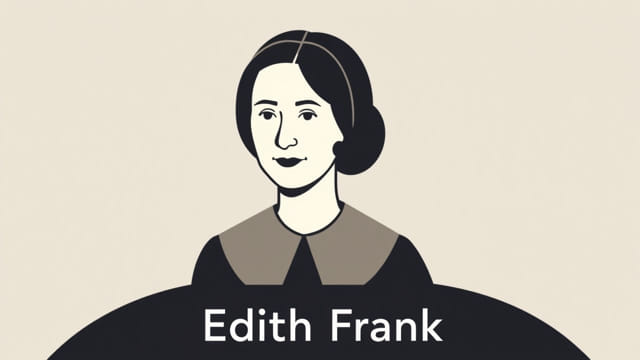
Edith Frank is best known as the mother of Anne Frank, the young Jewish girl whose diary has become one of the most powerful and enduring accounts of life during the Holocaust. But Edith’s own life, struggles, and personal journey offer deeper insight into the experience of Jewish families in Europe during the rise of Nazi power. She was not just a figure in her daughter’s story she was a woman of strength, resilience, and quiet sacrifice. Understanding who Edith Frank was adds another layer of meaning to the tragedy and the hope embedded in the legacy of Anne Frank.
Early Life and Family Background
Edith Frank was born Edith Holländer on January 16, 1900, in Aachen, Germany, into a well-to-do German-Jewish family. Her father, Abraham Holländer, was a successful businessman who owned an industrial business, and her mother, Rosa Holländer, maintained a warm, cultured home. Edith was the youngest of four children, and her childhood was marked by comfort, education, and a strong sense of family tradition.
The Holländer family lived in a relatively liberal and assimilated environment. Although they were Jewish, their daily lives were largely secular, a common trait among many middle-class Jewish families in Germany during that time. Edith was educated in Aachen and briefly studied French and art in a finishing school in Belgium. Her upbringing shaped her into a thoughtful, family-oriented woman who valued cultural life and education.
Marriage to Otto Frank
In 1925, Edith Holländer married Otto Frank, a fellow German Jew from a prominent banking family. The couple settled in Frankfurt and began their life together in a stable and supportive community. They had two daughters: Margot, born in 1926, and Anne, born in 1929. Edith dedicated herself to family life, raising her children and maintaining their home with care and love.
As the Nazi regime rose to power in the early 1930s, the Franks like many other Jewish families began to feel increasing fear and uncertainty. Anti-Semitic laws and sentiments were spreading rapidly, and Edith, though rooted in her German identity, was deeply concerned for the safety of her family. By 1933, the Franks made the painful decision to leave Germany and seek refuge in the Netherlands, where Otto began working for a company in Amsterdam.
Life in Amsterdam Before the War
In Amsterdam, Edith faced the immense challenge of rebuilding a new life in a foreign country. She struggled with the Dutch language and felt isolated, especially as Otto was often away for work and her daughters quickly adapted to their new surroundings. Nonetheless, Edith remained devoted to her family and took pride in creating a safe and nurturing environment.
Though life in the Netherlands was more secure than in Germany, the shadow of Nazism continued to spread. When the Nazis invaded the Netherlands in 1940, Jewish families including the Franks were again subject to discriminatory laws, restrictions, and fear of arrest. Edith and Otto began making contingency plans, preparing for the unthinkable.
Hiding in the Secret Annex
In July 1942, facing deportation orders for their eldest daughter Margot, the Frank family went into hiding in the now-famous Secret Annex located behind Otto Frank’s business premises. Together with four other Jews, they lived in cramped and tense conditions for over two years.
Edith’s role during this period was crucial. She did her best to hold the family together, maintain emotional stability, and ration food and resources. Despite the unbearable conditions, she worked hard to protect her daughters’ sense of hope and dignity. Her relationship with Anne was sometimes strained, as recorded in Anne’s diary, but such tension is not uncommon in confined spaces and stressful conditions. Edith’s patience, compassion, and fortitude are more clearly recognized in historical accounts outside the diary itself.
Arrest and Deportation
In August 1944, the Secret Annex was betrayed, and all its inhabitants were arrested by the Gestapo. The Franks were first sent to Westerbork transit camp, and then deported to Auschwitz in September 1944. Upon arrival, the family was separated. Edith remained with her daughters, while Otto was taken to the men’s camp.
Life in Auschwitz was a descent into horror. Despite hunger, cold, and the constant threat of death, Edith refused to eat all her food portions, giving extra to her daughters to help them survive. Her maternal devotion was a testament to her enduring strength. Tragically, in January 1945, Edith Frank died of starvation and exhaustion just weeks before Auschwitz was liberated by the Soviet army.
Legacy and Recognition
While Anne Frank’s diary made her name internationally known, the life and suffering of Edith Frank remain less acknowledged. However, historical researchers and Holocaust educators have emphasized the importance of understanding the experiences of people like Edith, who represent the millions of Jewish mothers, wives, and daughters lost during the Holocaust.
Edith Frank’s story contributes to the broader narrative of the Holocaust in several important ways:
- She represents the struggles of Jewish women during the rise of Nazism and war.
- Her sacrifices highlight the depth of parental love and resilience in the face of dehumanization.
- Her story, when viewed alongside Anne’s, offers a more complete picture of the Frank family and the broader Jewish experience.
Lessons from Edith Frank’s Life
Edith’s quiet strength teaches us about the courage found in everyday actions holding a family together, offering comfort in despair, and putting the needs of others before oneself. She may not have left a written record like her daughter, but her life is preserved through the memories of those who survived, including Otto Frank, who deeply mourned her loss.
Her journey is also a reminder of the cost of intolerance and hatred. Edith was a loving mother, a loyal wife, and a woman of deep compassion, caught in the gears of history’s darkest moment. Her story calls on us to remember not just the famous, but all those who suffered in silence.
Edith Frank’s legacy continues to inspire reflection and empathy. She was more than Anne Frank’s mother she was a woman of character who lived through extraordinary hardship with courage and devotion. Remembering her helps us to understand the human side of history and ensures that the stories of countless others like her are not forgotten. In learning about Edith Frank, we honor her life and the countless sacrifices made by families during the Holocaust.