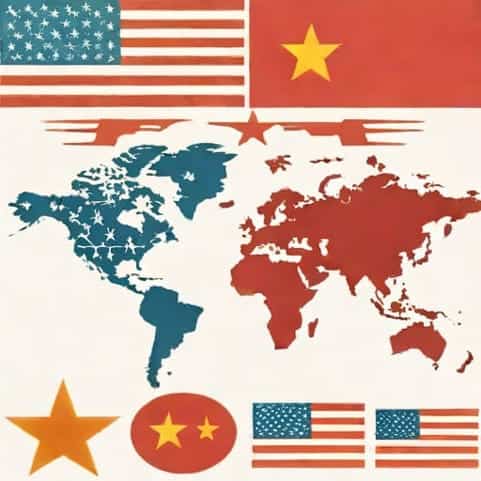
The United States’ deterrence strategy against China has become a central focus of international security and foreign policy in recent years. As China continues to expand its military capabilities, assert territorial claims in the South China Sea, and challenge U.S. influence in the Indo-Pacific region, Washington has implemented a combination of diplomatic, military, and economic measures to counter potential threats. Deterrence is aimed at preventing aggressive actions by demonstrating that any hostile moves would carry significant costs. The U.S. strategy relies on a mix of conventional and nuclear capabilities, alliances with regional partners, and strategic messaging designed to maintain stability while discouraging confrontation. Understanding the multifaceted approach of U.S. deterrence against China sheds light on the complexities of modern international relations and the evolving dynamics of great power competition.
Historical Context of U.S.-China Relations
The U.S.-China relationship has undergone significant changes over the past several decades. During the Cold War, the United States engaged China primarily as a counterbalance to the Soviet Union, leading to rapprochement in the 1970s. However, the post-Cold War era brought new challenges as China pursued rapid economic growth and expanded its military capabilities. Territorial disputes in the South and East China Seas, along with increased Chinese influence in global institutions, have led the U.S. to focus on deterrence strategies to prevent potential conflicts and preserve freedom of navigation in key maritime regions.
Components of U.S. Deterrence Strategy
Military Presence and Forward Deployment
The United States maintains a significant military presence in the Indo-Pacific region to reassure allies and deter potential aggression. Forward-deployed forces, including naval fleets, airpower, and missile defense systems, serve as a visible demonstration of U.S. commitment to regional security. Joint military exercises with partners such as Japan, South Korea, Australia, and the Philippines enhance readiness and interoperability, signaling that the U.S. is capable of responding swiftly to any hostile actions by China.
Alliances and Partnerships
Alliances play a crucial role in U.S. deterrence. Organizations such as the North Atlantic Treaty Organization (NATO) and partnerships with regional actors form a network of support that increases the potential costs of Chinese aggression. The U.S. engages in trilateral and quadrilateral dialogues, including the Quad with Japan, India, and Australia, to coordinate strategies and strengthen diplomatic ties. These alliances amplify U.S. capabilities and reinforce the message that any aggressive action by China would encounter collective resistance.
Economic Measures and Sanctions
Economic leverage is another pillar of deterrence. The U.S. employs targeted sanctions, export controls, and trade restrictions to signal disapproval of destabilizing actions and to limit China’s access to advanced technologies. By combining economic and military tools, the United States increases the potential costs for China in case of escalation. Economic deterrence complements traditional military deterrence, creating a multidimensional approach to preventing conflict.
Technological and Cyber Capabilities
Technological superiority is critical to U.S. deterrence efforts. Advanced missile systems, surveillance satellites, and cyber capabilities provide the ability to detect, monitor, and respond to Chinese actions. The United States also invests in artificial intelligence, quantum computing, and missile defense systems to maintain a competitive edge. These technological capabilities enhance deterrence by ensuring that China cannot achieve strategic surprise or gain an advantage in critical areas.
Regional Deterrence in the Indo-Pacific
The Indo-Pacific region is the primary focus of U.S. deterrence against China. The South China Sea, East China Sea, and Taiwan Strait are areas of heightened tension, where Chinese military activities have prompted U.S. responses. Freedom of navigation operations (FONOPs) conducted by the U.S. Navy assert international maritime rights and challenge excessive territorial claims. U.S. support for Taiwan, including arms sales and military training, serves as a direct deterrent against potential Chinese military action. By projecting power and reassuring allies, the U.S. seeks to maintain regional stability while discouraging unilateral aggressive actions.
Strategic Messaging and Communication
Deterrence relies not only on capabilities but also on signaling intentions. Clear communication about red lines and potential consequences helps reduce the risk of miscalculation. The U.S. employs public statements, diplomatic channels, and military demonstrations to convey that aggression would be met with proportionate and decisive responses. By combining ambiguity with credible deterrent threats, Washington aims to shape Chinese decision-making while avoiding unnecessary escalation.
Challenges and Limitations
Despite its robust deterrence strategy, the United States faces several challenges. China’s growing military sophistication, including anti-access/area-denial (A2/AD) capabilities, complicates U.S. operational planning. Regional allies have varying threat perceptions and strategic priorities, which can affect the coherence of collective deterrence. Additionally, economic interdependence between the U.S. and China limits the scope of punitive measures, as excessive economic confrontation could have global repercussions. Maintaining effective deterrence requires constant adaptation to evolving military, technological, and political conditions.
Risk of Miscalculation
One of the inherent risks in deterrence strategies is miscalculation. Ambiguity, signaling errors, or misunderstandings could lead to unintended escalation. Both the U.S. and China must navigate a delicate balance between demonstrating resolve and avoiding provocative actions that could spark conflict. Diplomatic engagement, crisis communication mechanisms, and military transparency are essential components to manage this risk effectively.
Balancing Deterrence and Diplomacy
U.S. deterrence against China is closely tied to broader diplomatic efforts. While military capabilities and economic measures are critical, dialogue and negotiation remain important tools to prevent conflict. Strategic competition does not preclude cooperation on global issues such as climate change, trade, and public health. Balancing deterrence with diplomacy ensures that tensions do not spiral into open confrontation while maintaining U.S. credibility and influence.
Future Prospects
The evolving U.S.-China dynamic will continue to shape deterrence strategies. Emerging technologies, shifts in regional alliances, and changing global power balances will influence how Washington adapts its approach. Strengthening partnerships in the Indo-Pacific, investing in advanced military capabilities, and maintaining credible signaling will remain key components of U.S. deterrence. Policymakers must consider both short-term crises and long-term strategic competition to ensure that deterrence remains effective without provoking unnecessary conflict.
U.S. deterrence against China is a complex, multidimensional strategy that combines military presence, alliances, economic measures, technological superiority, and strategic communication. The goal is to prevent aggressive actions by demonstrating the potential costs of escalation while maintaining regional stability. Challenges such as miscalculation, technological competition, and economic interdependence require careful management. By balancing deterrence with diplomacy and continuously adapting to changing circumstances, the United States seeks to maintain its influence in the Indo-Pacific and discourage actions that could destabilize the international order. Understanding this strategy provides insight into the nature of contemporary great power competition and the importance of maintaining peace through credible deterrence.