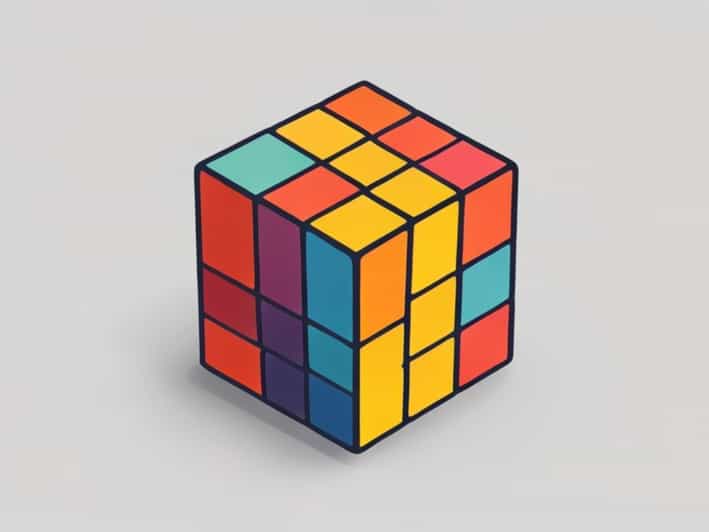
Solving a 3×3 Rubik’s Cube can seem intimidating at first glance, but with the right formula and understanding of its movements, anyone can master it. The Rubik’s Cube solver 3×3 formula is based on a sequence of algorithms designed to position and orient each piece correctly. These algorithms are not random moves they follow logic and structure that gradually bring the cube from a scrambled state to a perfectly aligned one. Whether you are a beginner or someone looking to improve your solving speed, learning these step-by-step formulas will make the process much easier and more enjoyable.
Understanding the Rubik’s Cube Basics
Before diving into the Rubik’s Cube solver 3×3 formula, it’s important to understand the cube’s structure and notation. The cube has six faces, each identified by color white, yellow, blue, green, red, and orange. Each face consists of a 3×3 grid of smaller cubes, known as cubies or cubelets.
Movements on the cube are represented by specific letters that indicate which face to turn and in which direction
- RRight face clockwise
- R’Right face counterclockwise
- LLeft face clockwise
- L’Left face counterclockwise
- UUpper face clockwise
- U’Upper face counterclockwise
- DDown face clockwise
- D’Down face counterclockwise
- FFront face clockwise
- F’Front face counterclockwise
- BBack face clockwise
- B’Back face counterclockwise
By combining these moves in certain sequences, you can manipulate the cube methodically rather than randomly twisting pieces around.
The Layer-by-Layer Solving Method
The most common way to solve a Rubik’s Cube 3×3 is the Layer-by-Layer method. This approach involves solving the cube one layer at a time starting from the white cross on the bottom, then the middle layer, and finally the yellow layer on top. Each layer requires a different algorithm, or formula, to move the cube pieces without disrupting what’s already solved.
Step 1 Solving the White Cross
The first step in the Rubik’s Cube solver 3×3 formula is to create a white cross on the bottom face. This means aligning the white edge pieces with both the white center and their matching side colors.
There is no single fixed algorithm for this step, as it mostly requires intuitive movement. However, keep rotating the white edges until they form a cross pattern. Make sure that the side colors on the edges also match the center pieces on adjacent faces.
Step 2 Solving the White Corners
Once the cross is complete, the next goal is to place the four white corner pieces in their correct spots. Each corner has three colors, and they must match the centers of the three corresponding faces.
Use this algorithm to place a corner piece correctly
R’ D’ R D
Repeat this sequence several times for each misplaced corner until the white corner piece is in its correct position. Move to the next corner and continue until the entire white face is completed.
Step 3 Solving the Middle Layer Edges
After finishing the white face, turn the cube upside down so that the yellow face is now on top. The next step involves solving the four edge pieces in the middle layer. Each edge piece should match the center colors on the front and side faces.
If an edge needs to go to the right, use the following algorithm
U R U’ R’ U’ F’ U F
If an edge needs to go to the left, use this one
U’ L’ U L U F U’ F’
Repeat the appropriate formula until all middle layer edges are correctly placed, completing the first two layers of the cube.
Step 4 Creating the Yellow Cross
Now that the bottom two layers are solved, the next objective is to form a yellow cross on the top layer. This step does not focus on the corners yet just the edges.
There are three possible patterns a single yellow dot (no edges), an L shape, or a straight line. Use the following algorithm to progress toward a yellow cross
F R U R’ U’ F’
Repeat this formula until you achieve the yellow cross shape on the top face. Don’t worry if the corners are not solved yet that will come later.
Step 5 Positioning the Yellow Edges
After forming the yellow cross, check if the yellow edge pieces are aligned with the centers of the sides. If not, use this algorithm to rotate them into the correct position
R U R’ U R U2 R’
This step ensures all yellow edge pieces are correctly positioned without disturbing the cross pattern you created.
Step 6 Positioning the Yellow Corners
Now focus on positioning the yellow corners in their correct locations, even if they are not yet oriented properly. To do this, look for a corner that is already in the right place and hold it in the front-right position. Then perform this formula
U R U’ L’ U R’ U’ L
Repeat until all four corners are in the correct location. Some may still have the wrong orientation, but that will be fixed in the next step.
Step 7 Orienting the Yellow Corners
The final step in the Rubik’s Cube solver 3×3 formula is to rotate the yellow corners so that the yellow face is fully complete. Hold the cube so that an unsolved yellow corner is in the front-right position and use this algorithm
R’ D’ R D
Keep repeating the formula until the yellow piece is oriented correctly. Rotate the top layer to move another unsolved corner into the same position and repeat the process. Do not worry if it seems like the cube is being scrambled it will realign when the final corner is oriented correctly.
Final Adjustments and Alignment
After orienting all the yellow corners, your cube should now be solved. If not, make minor rotations of the top or bottom layers to ensure all faces match perfectly. The more you practice, the faster and more natural this entire process becomes.
Tips for Mastering the Formula
- Learn one step at a time. Don’t try to memorize all algorithms in one session.
- Use finger tricks to perform moves faster once you are comfortable with the formulas.
- Practice pattern recognition. Spotting cube positions quickly helps reduce solving time.
- Stay patient. Even professional speedcubers started by mastering basic algorithms slowly.
The Rubik’s Cube solver 3×3 formula provides a clear, structured method for solving one of the world’s most famous puzzles. By following the layer-by-layer approach and learning a handful of simple algorithms, anyone can solve a cube from scratch. Over time, the movements become intuitive, allowing you to solve the cube faster and more efficiently. What once looked like an impossible challenge turns into an enjoyable mental exercise that sharpens memory, logic, and patience all thanks to the precise yet accessible Rubik’s Cube 3×3 formula.