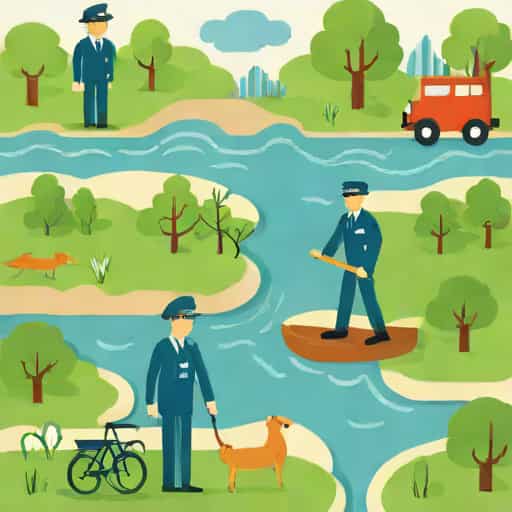
The river crossing puzzle involving a policeman and a robber is a classic logic problem that has fascinated puzzle enthusiasts for decades. This type of problem challenges critical thinking, strategic planning, and problem-solving skills by requiring participants to consider constraints and sequences of actions carefully. In this puzzle, the goal is typically to move all characters across a river using a boat, but there are strict rules about who can be left alone with whom. Although it appears simple at first glance, the puzzle requires logical reasoning to avoid scenarios where rules are violated, such as leaving the robber alone with civilians or family members without the policeman present. The scenario provides a fun yet educational way to engage both children and adults in developing cognitive skills.
Understanding the River Crossing Puzzle
The river crossing puzzle with a policeman and a robber is part of a larger family of puzzles that involve transporting individuals across a river using a boat that has limited capacity. The puzzle is designed to challenge the solver to find a sequence of moves that satisfy all constraints while achieving the goal of moving everyone safely to the other side. In its simplest form, the puzzle involves a policeman, a robber, and potentially additional characters such as civilians or family members. The main challenge arises from the rule that the robber cannot be left alone with other characters unless the policeman is present. This restriction introduces strategic decision-making and requires careful planning to prevent the robber from causing trouble.
Rules and Constraints
Every river crossing puzzle has specific rules that make it a logical challenge rather than a simple task. For the policeman and robber puzzle, the common rules include
- Only a limited number of individuals can fit in the boat at one time, often one or two people.
- The robber cannot be left alone with civilians or family members on either riverbank without the policeman present.
- The policeman can operate the boat, ensuring that he can transport individuals safely.
- The goal is to move everyone from the starting bank to the opposite bank without violating the rules.
Understanding these rules is essential because ignoring any constraint can result in an invalid solution. The puzzle encourages methodical thinking and careful evaluation of each step, as one wrong move can undo all previous progress.
Step-by-Step Solution Strategies
Solving the river crossing puzzle with a policeman and robber often requires a systematic approach. One effective strategy is to analyze the problem backward, starting from the goal and considering what moves must have preceded it. Another approach is to use trial and error combined with logic to identify sequences of crossings that maintain the rules. Solvers often write down each step and keep track of who is on each riverbank after every move. Using diagrams or tables can also be helpful for visualizing possible configurations and avoiding situations where the robber is left alone with others.
Sample Solution
While variations of this puzzle exist, a common scenario can be solved as follows. Assume there is one policeman and one robber with a boat that can carry only one or two people
- Step 1 The policeman takes the robber across the river.
- Step 2 The policeman returns alone to the starting bank.
- Step 3 The policeman takes another character (if present) across the river.
- Step 4 The policeman returns with the robber to the starting bank if needed.
- Step 5 Repeat these steps carefully until all characters are safely on the opposite bank.
This sequence may vary depending on the number of additional characters involved, but the key principle is that the policeman must always be present when the robber is in a potentially dangerous situation. Following a systematic approach ensures that the puzzle is solved correctly without violating any rules.
Educational Benefits of the Puzzle
The river crossing puzzle, including the policeman and robber version, is more than just a game; it has significant educational value. Solving these puzzles helps improve logical reasoning, critical thinking, and problem-solving skills. It encourages individuals to think several steps ahead, plan strategically, and understand the consequences of each action. Additionally, such puzzles can enhance memory and concentration as solvers track multiple characters and conditions throughout the process. Teachers and parents often use these puzzles to engage children in learning while making the activity enjoyable and interactive.
Variations of the Puzzle
There are many variations of the river crossing puzzle that introduce new elements and challenges. Some versions include multiple robbers, additional civilians, or children, each with their own constraints. Other variations may increase the complexity by adding limited boat trips, different movement rules, or time-based challenges. Each variation requires solvers to adapt their strategies and think creatively. By experimenting with different versions, solvers can improve their analytical abilities and learn how to handle complex problems in a structured way.
Tips for Solving River Crossing Puzzles
- Always analyze the constraints carefully before making a move.
- Visualize each step using diagrams or lists to track who is on each bank.
- Consider the consequences of leaving certain characters together on one bank.
- Start with simpler versions of the puzzle to build confidence before attempting more complex variations.
- Practice patience and logical thinking; rushing can lead to mistakes.
- Break the problem into smaller segments and solve each segment methodically.
Applications in Real Life
While the policeman and robber river crossing puzzle is a theoretical problem, the thinking skills it develops are highly applicable in real life. Strategic planning, risk assessment, and decision-making are essential in fields such as project management, law enforcement, education, and emergency response. The puzzle teaches individuals to evaluate constraints, consider multiple possibilities, and implement a step-by-step plan to achieve a goal safely and efficiently. It also demonstrates the value of patience, foresight, and careful monitoring of progress, skills that are transferable to many professional and personal scenarios.
The river crossing puzzle involving a policeman and a robber is an engaging and intellectually stimulating challenge that combines logic, strategy, and careful planning. By understanding the rules and constraints, visualizing each step, and applying systematic strategies, solvers can successfully navigate the puzzle while avoiding rule violations. Beyond its entertainment value, the puzzle fosters critical thinking, problem-solving, and decision-making skills that are valuable in everyday life. With countless variations and increasing complexity, this classic puzzle continues to captivate minds of all ages and serves as a timeless tool for education, cognitive development, and recreational problem-solving.