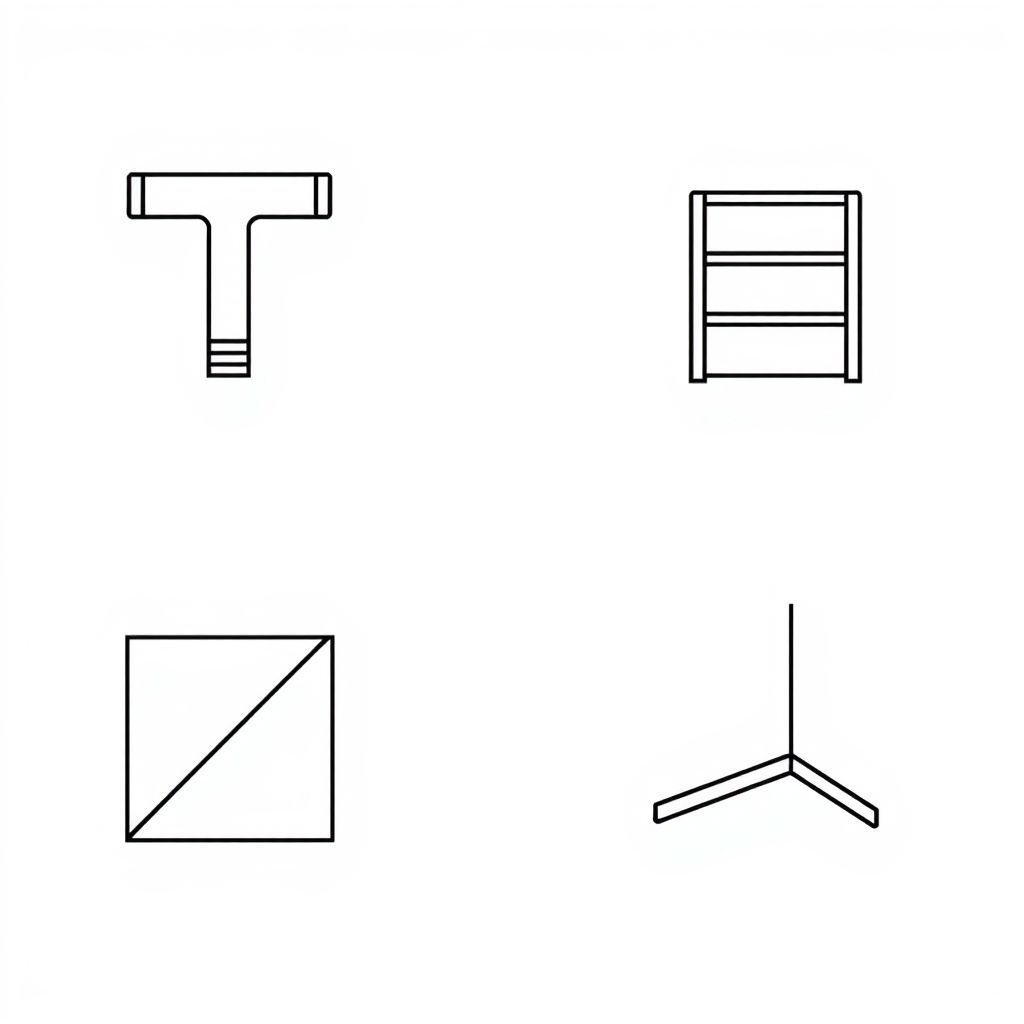
Perpendicular lines are a common concept in geometry, but they are not just confined to textbooks and classrooms. These lines form right angles where they meet and are essential in our everyday environment. From architecture to transportation and even furniture design, examples of perpendicular lines can be found all around us. Understanding these examples helps deepen our appreciation for how geometry plays a practical role in shaping the world we live in.
Understanding Perpendicular Lines
Before diving into real life examples, it’s helpful to revisit what perpendicular lines are. In mathematics, two lines are said to be perpendicular if they intersect at a 90-degree angle. This concept is not only important in geometry but also has widespread applications in engineering, design, and construction.
Key Characteristics of Perpendicular Lines
- They form right angles (90 degrees) when they intersect.
- They appear in many man-made and natural structures.
- They are crucial for ensuring balance, symmetry, and structural stability.
Examples of Perpendicular Lines in Daily Life
Street Intersections
One of the most obvious examples of perpendicular lines is at street intersections. When two roads meet at a right angle, they form perpendicular lines. This layout is especially common in cities with a grid system, making navigation straightforward and enhancing traffic safety.
Buildings and Skyscrapers
In construction, vertical columns and horizontal beams often intersect at right angles to form the frame of a building. This perpendicular structure helps distribute weight evenly and provides stability. Window frames, door frames, and even the corners of walls also feature perpendicular lines to maintain symmetry and functionality.
Furniture and Home Fixtures
Furniture design makes extensive use of perpendicular lines. Tables, chairs, bookshelves, and cabinets all rely on right angles between legs and surfaces for balance and visual appeal. Even appliances like refrigerators and washing machines are designed with perpendicular sides for practicality and uniformity.
Books and Paper
Books provide another everyday example. The edges of pages are perpendicular to the spine, and lines on ruled paper are often perpendicular to the margins. This alignment helps with organization, readability, and aesthetic consistency in printed materials.
Railway Tracks and Crossings
Railway systems are designed with precision. Crossings, where two tracks intersect at right angles, provide a clear example of perpendicular lines. The rails themselves are typically laid parallel, but when a crossing occurs, the intersecting line forms a perpendicular angle for safety and operational efficiency.
Digital Screens and User Interfaces
Electronic devices, such as televisions, smartphones, and computer monitors, often feature screens with rectangular shapes, meaning the edges meet at right angles. User interface designs also use perpendicular lines in layout grids, ensuring a clean and organized appearance for buttons, menus, and text fields.
Whiteboards and Chalkboards
In classrooms and meeting rooms, whiteboards and chalkboards are mounted with perpendicular borders. These boards are often divided by horizontal and vertical lines to help organize writing and visuals, reinforcing the use of perpendicular structure in communication tools.
Sports Fields and Courts
Many sports fields and courts use perpendicular lines to mark boundaries and sections. For example
- Basketball courts have baselines and sidelines that meet at right angles.
- Soccer fields use perpendicular lines to define penalty boxes and goal areas.
- Baseball diamonds form a square, with each base connected by lines that are perpendicular at the corners.
Importance of Perpendicular Lines in Design
Stability and Strength
Perpendicular lines provide structural integrity in construction and design. When a horizontal base supports a vertical column at a right angle, the force of gravity is efficiently distributed, preventing collapse and ensuring longevity.
Visual Balance and Symmetry
Right angles contribute to a sense of balance in visual design. Perpendicular lines create a framework that is easy on the eyes and evokes a feeling of order, which is especially important in architecture, interior design, and art.
Functional Efficiency
Perpendicular layouts optimize space and function. In homes and offices, perpendicular walls help maximize usable floor area, and square or rectangular furniture fits seamlessly into corners and along walls, enhancing organization and accessibility.
Educational Relevance
Teaching Geometry Concepts
Using real life examples of perpendicular lines in the classroom helps students grasp geometry more effectively. When learners recognize right angles in their surroundings, abstract concepts become tangible, leading to better comprehension and retention.
Encouraging Observation and Critical Thinking
Exploring perpendicular lines in real life encourages students to observe more closely and think critically about their environment. This not only enhances spatial awareness but also promotes analytical thinking and problem-solving skills.
Technology and Engineering Applications
Mechanical Design
Engineers rely on perpendicular lines when designing mechanical systems. From car engines to machinery parts, right angles ensure precise alignment and movement, reducing wear and tear and enhancing durability.
Computer-Aided Design (CAD)
In computer-aided design software, perpendicular lines help define accurate shapes and dimensions. Designers use perpendicular constraints to create blueprints for everything from houses to industrial machines, ensuring perfection in every measurement.
Perpendicular lines are far more than a geometric concept confined to the pages of a textbook. They are a critical part of the structures we live in, the systems we rely on, and the tools we use daily. From street layouts and skyscrapers to furniture and digital devices, these right-angle intersections offer both functional benefits and aesthetic value. Recognizing real life examples of perpendicular lines not only strengthens our understanding of geometry but also helps us appreciate the role math plays in shaping the world around us. The next time you step into a room, look at a screen, or drive through an intersection, take a moment to notice the many right angles that keep our world aligned and orderly.