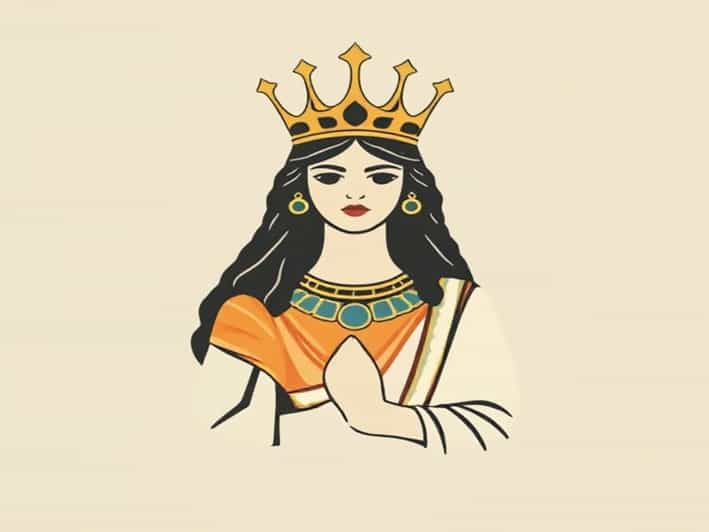
Queen Esther of Persia is remembered as one of the most influential women in ancient history, whose story is told in the Hebrew Bible within the Book of Esther. Her courage, intelligence, and sense of justice enabled her to change the fate of her people during a time of political instability. Known for her beauty and grace, Esther did not simply fulfill the role of a queen in ceremonial form; instead, she used her position to prevent the destruction of the Jewish population living in the Persian Empire. Her story continues to be honored and celebrated, especially during the Jewish festival of Purim, which commemorates her bravery and triumph.
Historical Setting of Persia
The story of Queen Esther takes place during the reign of King Ahasuerus, often identified historically with Xerxes I of Persia. The Persian Empire at that time was one of the most powerful empires in the world, stretching from India to Egypt. It was an era marked by wealth, grand architecture, and complex political structures. Royal decisions affected millions of people, and the king’s court was influenced by counselors, advisors, and nobles who held significant influence.
The Cultural Landscape
The Persian Empire was known for its cultural diversity. Many peoples lived under its rule, including Jews who had been exiled from their homeland. While they were given relative freedom to practice their customs, they were still vulnerable to discrimination and political schemes that could endanger their survival.
-
Persia was a diverse empire with multiple ethnic groups.
-
The Jewish population lived within this multicultural environment.
-
Court officials held significant power in decision-making.
This environment set the stage for Esther’s extraordinary rise to power and her decisive role in protecting her people.
Esther’s Early Life
Esther was not born into royalty. She was a Jewish orphan raised by her cousin and guardian, Mordecai. Her Hebrew name was Hadassah, meaning myrtle, a plant associated with beauty and righteousness. When the king sought a new queen after dismissing Queen Vashti, Esther was chosen among many young women brought to the palace.
The Selection of Esther
The selection of a queen was based not only on beauty but also on refinement, intelligence, and grace. Esther’s gentle nature and modesty set her apart. However, Mordecai instructed her not to reveal her Jewish identity due to social and political tensions.
-
Esther did not seek the role; it came to her unexpectedly.
-
She adapted to palace life with humility and wisdom.
-
Her identity remained a secret, which would later become crucial.
Her position as queen placed her in an environment of influence, but it also required caution.
The Threat to the Jewish People
The central conflict of Esther’s story arose when Haman, a powerful advisor to the king, plotted to destroy the Jewish population. Haman’s anger grew when Mordecai refused to bow to him, prompting him to seek revenge not only against Mordecai but against all Jews in the empire.
Haman’s Decree
Haman convinced King Ahasuerus to issue a decree that authorized the elimination of Jews throughout Persia. The decree was sealed with the king’s authority, making it a legal and irreversible order.
-
The decree threatened an entire community.
-
Fear and confusion spread among the Jewish people.
-
Mordecai called upon Esther to intervene.
Esther now faced a life-changing choice remain silent and safe, or speak up and risk her life to save her people.
Queen Esther’s Courage
Approaching the king without being summoned was forbidden and could result in death. Yet Esther understood that silence would allow Haman’s plot to succeed. After praying and fasting for strength, she went before the king, demonstrating remarkable bravery.
The Banquet Strategy
Esther did not immediately accuse Haman. Instead, she hosted two banquets, building trust and creating a setting where the king would listen fully to her request. Her strategic approach displayed wisdom and patience.
-
Esther revealed her identity as a Jew.
-
She exposed Haman’s plot directly to the king.
-
The king ordered justice, saving the Jewish population.
Her courage changed the future of her people and solidified her legacy as a heroic figure.
The Celebration of Purim
The Jewish festival of Purim commemorates Esther’s bravery and the salvation of the Jewish people. It is a celebration filled with joy, storytelling, food, and community gatherings. People read the Book of Esther, exchange gifts, and share meals to honor the victory over oppression.
Lasting Cultural Significance
Purim highlights resilience, identity, and the power of decisive action. It reminds communities to speak up in the face of injustice and to recognize how individual courage can affect collective survival.
Legacy and Interpretation
Queen Esther of Persia has been interpreted in various ways throughout history. To some, she symbolizes faith guiding action. To others, she represents political intelligence and leadership. Her story is also seen as an example of women shaping history in times when power was often in the hands of men.
-
She is celebrated as a heroine in Jewish tradition.
-
Her story is studied in literature, religion, and social history.
-
Her courage is admired across cultures and generations.
Queen Esther of Persia was far more than a royal figure of beauty and grace. She was a woman of remarkable courage, strategic thinking, and strong moral conviction. Her story demonstrates how one person, even when faced with enormous risk, can alter the course of history. The legacy of Esther continues to inspire people to stand for justice, protect the vulnerable, and act with courage when confronted by adversity. Her influence has endured for centuries, proving that true leadership can emerge from unexpected places and transform the world.