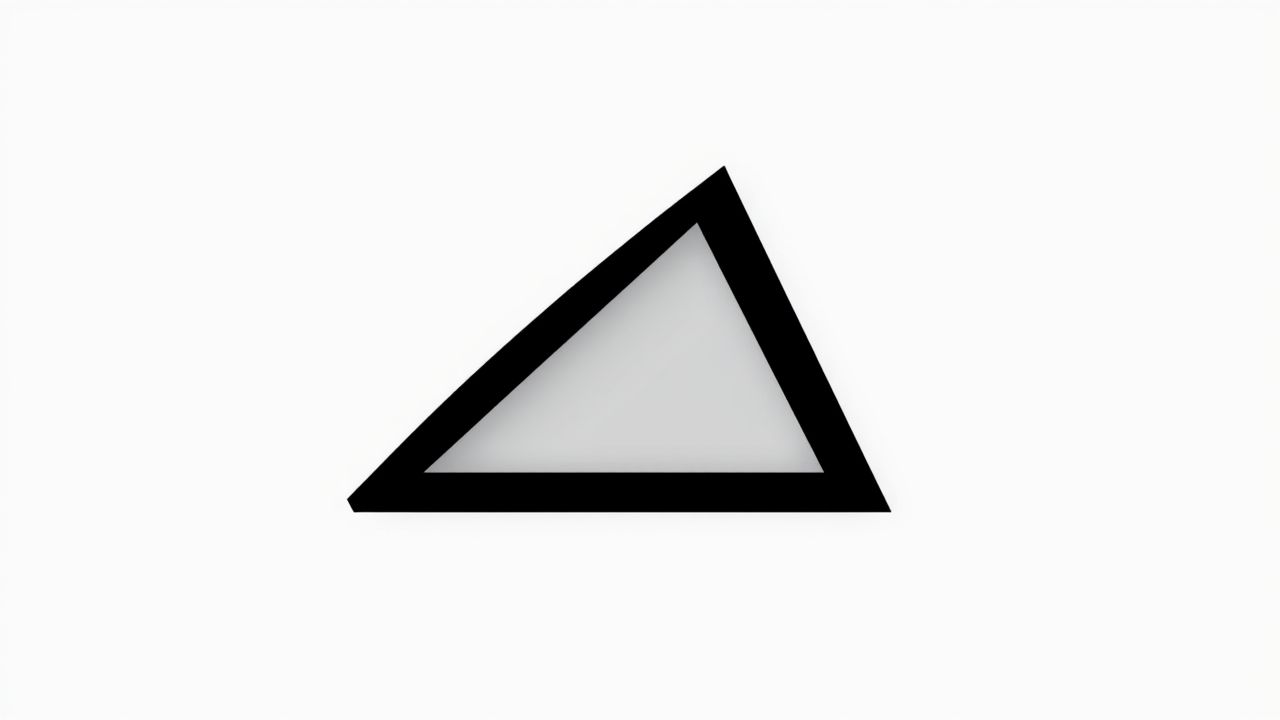
The right angle triangle is one of the most important and well-studied shapes in geometry. Its unique property of having one angle exactly equal to 90 degrees makes it a foundation for many mathematical concepts, including the Pythagorean theorem, trigonometry, and practical applications in engineering, architecture, and navigation. Understanding the parts, properties, and formulas related to a right angle triangle is essential for anyone who wants to build strong skills in mathematics and apply them to real-world problems.
Definition of a Right Angle Triangle
A right angle triangle is a triangle in which one of its angles is exactly 90 degrees. This right angle divides the triangle into two sides called the legs, which meet at the right angle, and a third side called the hypotenuse, which is the longest side of the triangle.
Key Components
- HypotenuseThe side opposite the right angle and the longest side of the triangle.
- Adjacent SideThe side next to the angle being considered (other than the hypotenuse).
- Opposite SideThe side opposite the angle being considered (other than the hypotenuse).
Properties of Right Angle Triangles
Right angle triangles have distinct mathematical properties that make them easy to analyze and useful in calculations
- One angle is exactly 90 degrees.
- The hypotenuse is always longer than either of the other two sides.
- The lengths of the sides are related by the Pythagorean theorem.
- Trigonometric ratios like sine, cosine, and tangent can be defined using the sides of the triangle.
The Pythagorean Theorem
One of the most famous results related to right angle triangles is the Pythagorean theorem. It states that in a right angle triangle, the square of the length of the hypotenuse is equal to the sum of the squares of the lengths of the legs.
Mathematicallyc² = a² + b²
- cis the length of the hypotenuse.
- aandbare the lengths of the other two sides.
This relationship allows us to find the length of any side of a right angle triangle if the other two are known.
Special Right Angle Triangles
Some right angle triangles have side lengths that follow simple patterns, making calculations easier.
45°-45°-90° Triangle
- This is an isosceles right angle triangle, meaning the two legs are equal in length.
- The hypotenuse is equal to the leg length multiplied by √2.
30°-60°-90° Triangle
- This triangle has one angle of 30 degrees, one of 60 degrees, and the right angle of 90 degrees.
- The hypotenuse is twice the length of the shorter leg, and the longer leg is the shorter leg multiplied by √3.
Trigonometric Ratios in a Right Angle Triangle
Right angle triangles are the basis of trigonometry, which relates angles to side lengths. The three main trigonometric ratios are
- Sine (sin)Opposite side / Hypotenuse
- Cosine (cos)Adjacent side / Hypotenuse
- Tangent (tan)Opposite side / Adjacent side
These ratios are essential for solving problems involving heights, distances, and angles when direct measurement is not possible.
Applications of Right Angle Triangles
Right angle triangles appear in various real-life contexts, from simple measurements to complex engineering designs. Here are some practical uses
Construction and Architecture
- Determining the correct slope of a roof.
- Calculating structural support angles.
- Designing ramps that meet accessibility standards.
Navigation and Mapping
- Using triangulation to determine distances.
- Calculating bearings and positions in navigation.
- Determining elevation in topographic mapping.
Physics and Engineering
- Analyzing forces acting at right angles in mechanics.
- Designing right-angled components for machines.
- Determining projectile motion using trigonometry.
Solving Right Angle Triangle Problems
There are several methods for solving unknown sides or angles in a right angle triangle, depending on the given information.
Using the Pythagorean Theorem
When two side lengths are known, the third can be found directly by rearranging the formula.
Using Trigonometric Ratios
When one side length and one acute angle are known, trigonometric functions can determine the remaining sides and angles.
Using Special Triangle Properties
If the triangle is a 45°-45°-90° or 30°-60°-90° triangle, you can use the known ratios to find missing sides quickly without complex calculations.
Right Angle Triangles in Coordinate Geometry
In coordinate geometry, right angle triangles are used to calculate distances between points, slopes of lines, and areas of shapes. By applying the Pythagorean theorem to coordinate points, you can determine the length of a line segment.
Right Angle Triangles in the Real World
From ancient Egyptian builders using knotted ropes to ensure precise right angles in pyramids, to modern-day engineers designing bridges and skyscrapers, right angle triangles have always been an essential tool. Even in everyday life, tasks such as measuring a ladder’s correct leaning angle or creating a perfect corner in a garden layout depend on the principles of this triangle.
The right angle triangle is much more than a simple geometric figure; it is a powerful mathematical tool with applications in countless fields. Its properties, governed by the Pythagorean theorem and trigonometric principles, allow for precise measurements, problem-solving, and creative designs. By mastering the concepts related to right angle triangles, one gains not only mathematical skills but also the ability to apply them in real-world scenarios where accuracy and efficiency are essential.