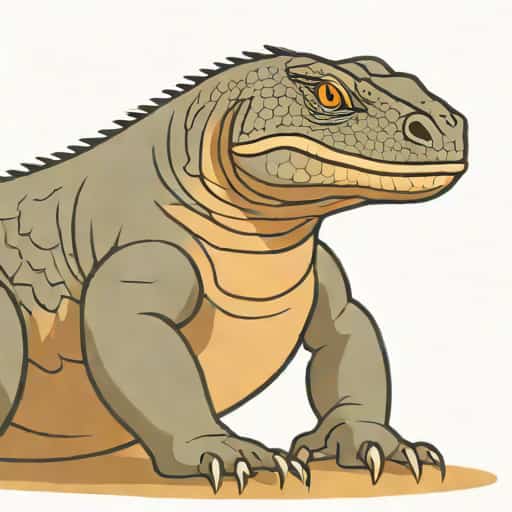
The Komodo dragon is often thought of as a living relic of prehistoric times, a creature that evokes images of ancient giants roaming a lost world. While it is not a dinosaur, the modern Komodo dragon’s existence and evolutionary history provide a fascinating glimpse into a prehistoric past when giant lizards flourished across wide regions of what is now Australia and Southeast Asia. Fossil evidence and scientific studies suggest that the ancestors of today’s Komodo dragon lived millions of years ago, adapting and surviving through dramatic changes in climate, geography, and ecosystems. Understanding the prehistoric roots of the Komodo dragon sheds light on its evolution, how it became the apex predator on isolated islands, and why it continues to capture the imagination of scientists and enthusiasts alike.
Evolutionary Roots of the Komodo Dragon
Komodo dragons belong to the genusVaranus, a group of monitor lizards that first appeared in Asia around 40 million years ago. These reptiles diversified and spread across continents, evolving into various species adapted to different environments. Fossil and genetic data indicate that the ancestors of modern Komodo dragons migrated from Asia to Australia and diversified into large-bodied lizards over millions of years. These early varanid lizards became well-established in Australia, where fossil evidence shows that relatives of today’s Komodo dragon lived from about four million years ago to as recently as 330,000 years ago. These ancient lizards were part of a broader trend of large varanids that once dominated the landscape alongside other megafauna.
The Australian Origin Hypothesis
Recent fossil discoveries have been crucial in shaping our understanding of Komodo dragon origins. Remains found in eastern Australia that date back several million years closely resemble the bones of modern Komodo dragons, suggesting that the species did not evolve in isolation on Indonesian islands but likely originated on the Australian continent. During the Pliocene and Pleistocene epochs, geological changes and fluctuating sea levels created land bridges between Australia and Southeast Asia. These connections allowed ancestral Komodo dragons to disperse westward into what is now Indonesia, eventually becoming isolated on islands such as Flores, Komodo, and Rinca as sea levels rose.
From Land Giants to Island Apex Predators
Once in Indonesia, these ancient lizards adapted to life on islands with distinct ecological challenges. The isolation of island environments meant fewer large mammalian predators, allowing monitor lizards to become the top carnivores in their ecosystems. Over time, natural selection favored traits that supported survival in these unique settings, such as powerful limbs, strong jaws, and efficient hunting strategies. Komodo dragons became large and formidable predators, capable of taking down prey many times their size and scavenging efficiently. As sea levels fluctuated, populations that remained on the mainland disappeared or became restricted to isolated brackish habitats, while island groups continued to thrive.
Adaptations and Survival Strategies
In prehistoric contexts and continuing into the modern era, Komodo dragons developed several key adaptations that helped them persist. Their long, forked tongues and excellent sense of smell allowed them to detect carrion and prey from long distances. Powerful limbs and claws provided strength for hunting and traversing rugged terrain, while their robust digestive systems enabled them to consume large quantities of meat and extract nutrients efficiently. In addition, recent research highlights that Komodo dragons possess venom glands, which may aid in subduing prey by introducing toxins that facilitate blood loss and shock, making them even more effective hunters.
Prehistoric Neighbors and Megafauna
The world in which Komodo dragon ancestors evolved was populated by other giant reptiles, some of which rivaled or exceeded their size. In Australia, species such asVaranus priscus, commonly known as Megalania, reached lengths that far surpassed those of modern Komodo dragons. Megalania, now extinct, is thought to have thrived alongside a diverse array of megafauna including large marsupials and giant herbivores. Although research has shown that Komodo dragons did not evolve specifically to prey on pygmy elephants or other dwarfed mammals-as once hypothesized-these large reptiles represent a broader pattern of gigantism among varanid lizards that evolved in complex ecosystems with abundant prey.
Prehistoric Ecosystems and Interactions
During the Pleistocene, Australia’s landscape supported a rich diversity of giant reptiles and mammals. The presence of both large varanids and substantial prey populations suggests dynamic ecological interactions where ancient Komodo ancestors and their relatives played significant roles as apex predators. As environments changed with the advance and retreat of glaciers and shifts in vegetation, these ecosystems evolved, eventually leading to the isolation and extinction of many large species. As the Australian climate became less hospitable and humans arrived, the range of large varanids diminished, leaving only isolated populations on islands such as those in Indonesia.
Not Dinosaurs, but Ancient Relatives
Although often called living dinosaurs in popular media due to their ancient appearance and formidable size, Komodo dragons are not direct descendants of dinosaurs. Dinosaurs went extinct about 66 million years ago, while the lineage leading to monitor lizards like the Komodo dragon diverged from early reptile ancestors well after the dinosaur era. Both Komodo dragons and dinosaurs share distant reptilian roots, but their evolutionary paths are distinct. Birds, for instance, are the true living descendants of certain dinosaur groups, not modern reptiles like Komodo dragons. Nevertheless, the prehistoric allure of these powerful lizards captures the imagination, making them iconic representatives of ancient reptilian success.
Evolutionary Divergence and Lineage
The family Varanidae, which includes monitor lizards, likely originated between 40 and 25 million years ago in Asia, later spreading to Australia and beyond. Over millions of years, varanid lizards diversified, producing a variety of species adapted to forests, deserts, and coastal regions. The Komodo dragon’s closest living relatives include the Australian lace monitor and other large monitor species, highlighting their shared ancestral ties and evolutionary history rooted in ancient ecosystems.
Modern Survival and Conservation
Today’s Komodo dragons are restricted to a handful of Indonesian islands, including Komodo, Rinca, Flores, and Gili Motang. While their prehistoric ancestors enjoyed wide distributions across vast landmasses, modern populations face threats such as habitat loss, human encroachment, and climate change. Conservation efforts in Komodo National Park and surrounding areas aim to protect these remarkable lizards and their ecosystems, preserving an evolutionary legacy that stretches back millions of years. The survival of Komodo dragons, from their prehistoric beginnings to the present day, underscores the resilience of life and the importance of maintaining biodiversity in a rapidly changing world.
Why Study Prehistoric Komodo Dragons?
Understanding the prehistoric history of Komodo dragons provides insight into evolutionary processes, the effects of geographic change on species distribution, and the dynamics of ancient ecosystems. It also enriches our appreciation of how modern species adapt to environmental pressures and survive through time. As living representatives of ancient reptilian lineage, Komodo dragons offer a rare opportunity to explore deep evolutionary history while emphasizing the need to protect these remarkable animals for future generations.