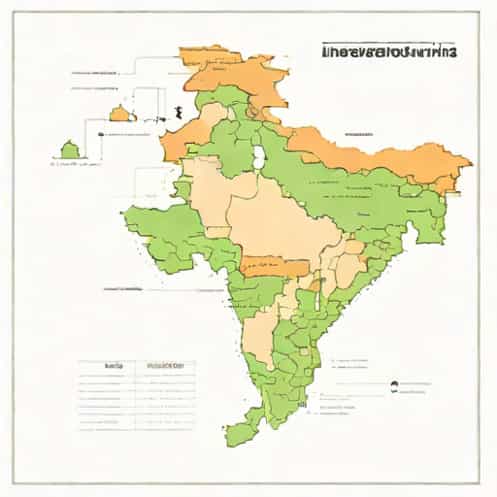
India, a country known for its rich cultural heritage and diverse landscapes, occupies a unique and strategic position on the global map. Its geographical location significantly influences its climate, biodiversity, trade routes, and geopolitical importance. India is situated in South Asia and is the seventh-largest country in the world by land area, encompassing an array of physical features ranging from the towering Himalayas in the north to the tropical beaches of the south. Understanding India’s geographical location provides insights into its environmental conditions, economic activities, and regional interactions.
Absolute Location of India
The absolute location of India is defined by its specific coordinates on the globe. India extends roughly between 8°4′ N to 37°6′ N latitude and 68°7′ E to 97°25′ E longitude. These coordinates place India predominantly in the Northern and Eastern Hemispheres. The country covers an area of approximately 3.287 million square kilometers, making it a vast nation with varied topography and climatic zones. Its absolute position near the Tropic of Cancer (approximately 23°30′ N) allows India to experience a wide range of climatic conditions, from tropical in the south to temperate and alpine in the north.
Relative Location of India
India’s relative location highlights its position concerning neighboring countries and bodies of water. India shares land borders with Pakistan to the northwest, China, Nepal, and Bhutan to the north, and Bangladesh and Myanmar to the east. To the south, it is bounded by the Indian Ocean, with Sri Lanka located nearby, separated by the Palk Strait. The Arabian Sea lies to the west, and the Bay of Bengal to the east. India’s central location in South Asia makes it a bridge between the Middle East, Southeast Asia, and Central Asia, which has historically made it a hub for trade, cultural exchange, and strategic military significance.
Physical Features Influencing India’s Geography
India’s geographical location is closely linked to its diverse physical features, which include mountains, plateaus, plains, and coastal areas. The country’s northern boundary is marked by the Himalayan mountain range, which acts as a natural barrier against extreme cold from Central Asia and has a significant impact on the climate and river systems. The Indo-Gangetic Plains, located south of the Himalayas, are fertile and support dense population centers and agricultural activities. The Peninsular Plateau in southern India features ancient rock formations and contributes to the varied landscape of the country.
Mountain Ranges and Plateaus
- HimalayasStretch across the northern border, including some of the highest peaks in the world such as Kanchenjunga and Nanda Devi.
- Vindhya and Satpura RangesRun across central India, separating northern plains from the southern plateau.
- Deccan PlateauA large triangular plateau in southern India bounded by the Eastern and Western Ghats.
Climate and Geographical Location
India’s geographical location directly affects its climate patterns. Being close to the equator and spanning several latitudes, India experiences diverse climatic zones. The northern regions experience cold winters and mild summers due to the Himalayas’ influence, while southern India remains tropical with warm temperatures year-round. The monsoon system, which brings the majority of India’s annual rainfall, is influenced by the country’s position between the Indian Ocean and the high-pressure systems of Central Asia. This geographic setup is critical for agriculture, water resources, and ecosystem sustainability.
Regional Climate Variations
- Himalayan NorthAlpine and subalpine climates with snowfall and cooler temperatures.
- Indo-Gangetic PlainsHot summers, cold winters, and heavy monsoon rains.
- Deccan PlateauSemi-arid to tropical climate with moderate rainfall.
- Coastal RegionsTropical climate with high humidity and moderate to heavy rainfall.
Strategic Importance of India’s Location
India’s geographical location confers considerable strategic and economic importance. Situated at the crossroads of Central Asia, Southeast Asia, and the Indian Ocean, India has historically been a center of trade, migration, and cultural exchange. Its location along major sea routes in the Arabian Sea and Bay of Bengal allows for international maritime trade, making ports like Mumbai, Chennai, and Kolkata vital for commerce. Geopolitically, India’s position near volatile regions necessitates strong defense mechanisms and regional diplomacy.
Proximity to Neighboring Countries
- PakistanNorthwest neighbor influencing defense and trade policies.
- ChinaNorthern neighbor with shared borders in the Himalayas.
- Nepal and BhutanNorthern neighbors providing access to Himalayan trade routes.
- Bangladesh and MyanmarEastern neighbors crucial for regional connectivity.
India’s Coastal Geography
India’s extensive coastline of over 7,500 kilometers includes the mainland coast and the islands, enhancing its maritime influence. The western coastline along the Arabian Sea and the eastern coastline along the Bay of Bengal support fisheries, shipping, and tourism. India’s strategic location in the Indian Ocean also positions it as a key player in regional maritime security and international shipping lanes. The geographical location of India’s islands, such as the Andaman and Nicobar Islands, further expands its maritime domain and provides a strategic advantage in regional defense and trade.
Islands and Maritime Zones
- Andaman and Nicobar IslandsLocated in the Bay of Bengal, crucial for maritime security and biodiversity.
- Lakshadweep IslandsLocated in the Arabian Sea, supporting fishing and coastal trade.
Geographical Location and Biodiversity
India’s geographical position between 8° and 37° N latitude and its diverse terrain contribute to rich biodiversity. The northern Himalayas host unique alpine flora and fauna, while the Western Ghats, recognized as a biodiversity hotspot, feature tropical rainforests and endemic species. Coastal regions provide habitats for marine life, including coral reefs, mangroves, and sea turtles. This diverse geography makes India one of the 17 megadiverse countries in the world, highlighting the significance of its location for ecological conservation.
India’s geographical location is a defining feature of its identity, influencing climate, biodiversity, economic activities, and strategic importance. Located in South Asia between 8°4′ N to 37°6′ N latitude and 68°7′ E to 97°25′ E longitude, India connects the Northern and Eastern Hemispheres. Its borders with neighboring countries, extensive coastline, and position in the Indian Ocean make it crucial for regional trade and geopolitics. The diverse physical features, ranging from the Himalayas to coastal plains, shape its climatic zones and natural resources. Understanding the geographical location of India provides insight into its historical development, contemporary significance, and future potential as a key player on the global stage.