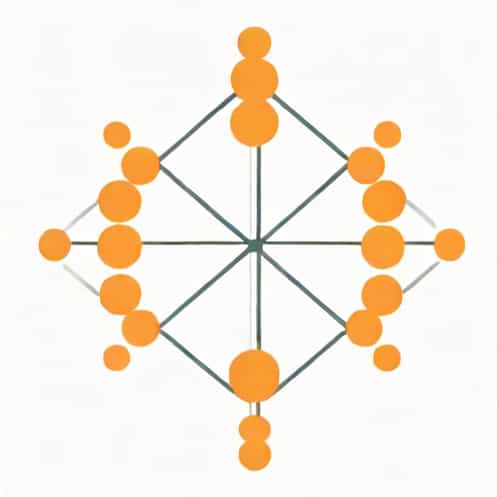
A bipartite graph is a special type of graph in mathematics and computer science where the set of vertices can be divided into two distinct groups such that no two vertices within the same group are connected by an edge. Understanding examples of bipartite graphs is essential in various fields, including network analysis, scheduling problems, and database relationships. These graphs are widely used to model relationships where interactions occur only between two different types of entities, such as students and courses, employees and projects, or buyers and sellers. Exploring concrete examples of bipartite graphs can help in visualizing their applications and understanding their significance in problem-solving.
Definition and Key Characteristics of Bipartite Graphs
A bipartite graph consists of two sets of vertices, commonly denoted as U and V, with edges connecting vertices from one set to vertices in the other set. There are no edges connecting vertices within the same set. This characteristic distinguishes bipartite graphs from other types of graphs and provides useful properties for analyzing relationships and solving optimization problems. Bipartite graphs are often represented as G = (U, V, E), where E is the set of edges connecting vertices from U to V.
Properties of Bipartite Graphs
- The vertex set can be partitioned into two disjoint subsets U and V.
- No two vertices in the same subset are adjacent.
- Bipartite graphs do not contain odd-length cycles.
- They are used to model relationships between two distinct types of entities.
- Perfect matchings and maximum matchings can often be identified efficiently in bipartite graphs.
Simple Examples of Bipartite Graphs
Understanding simple examples of bipartite graphs helps illustrate how these structures work in practical scenarios. These examples demonstrate the clear division between the two sets of vertices and the relationships represented by edges connecting them.
Student-Course Enrollment
Consider a university scenario where students enroll in courses. One set of vertices represents students, and the other set represents courses. An edge connects a student to a course if that student is enrolled in the course. For instance, if we have students S1, S2, and S3, and courses C1, C2, and C3, a bipartite graph can show which student is taking which course. No edges connect students directly to other students or courses directly to other courses, making it a classic example of a bipartite graph used in educational data analysis.
Employee-Project Assignment
In a corporate setting, employees are often assigned to different projects. One set of vertices represents employees, and the other set represents projects. Edges indicate which employee is assigned to which project. For example, Employee E1 may work on Project P1 and P2, Employee E2 on Project P2 and P3, and so on. This bipartite representation helps managers visualize workloads, ensure balanced assignment, and analyze team collaboration patterns.
Buyer-Seller Networks
In e-commerce or trading platforms, a bipartite graph can model relationships between buyers and sellers. One set of vertices represents buyers, and the other set represents sellers. Edges connect buyers to the sellers from whom they purchase products. This structure is useful for analyzing customer behavior, identifying popular sellers, and recommending products. It also facilitates understanding interactions between two distinct entities in a marketplace.
Applications of Bipartite Graphs
Bipartite graphs are not just theoretical constructs; they have practical applications in computer science, operations research, and social network analysis. By representing relationships between two distinct sets, these graphs simplify complex problems and allow for efficient solutions using algorithms specifically designed for bipartite structures.
Matching Problems
One of the most common applications of bipartite graphs is in matching problems. A matching is a set of edges without common vertices, and a perfect matching occurs when every vertex in both sets is matched. Examples include assigning students to dorm rooms, employees to shifts, or tasks to machines. Bipartite graphs provide a clear framework for solving these problems using algorithms like the Hungarian algorithm or maximum flow methods.
Network Flow Analysis
Bipartite graphs are used in network flow analysis to model connections between two types of nodes. For instance, in transportation networks, stations and buses can form two vertex sets, with edges representing routes. This representation allows analysts to optimize flow, minimize congestion, and improve efficiency in logistics and supply chain management.
Recommendation Systems
In recommendation systems, bipartite graphs are frequently used to model interactions between users and items. One set represents users, and the other set represents items such as movies, books, or products. Edges indicate user preferences or past interactions. Algorithms such as collaborative filtering leverage these bipartite structures to suggest items to users based on patterns of connections, improving user experience and engagement.
Visualizing Bipartite Graphs
Visual representation is essential for understanding the structure of bipartite graphs. Vertices from the two sets are often arranged in parallel layers, with edges connecting vertices from one layer to the other. This layout clearly illustrates the absence of edges within the same set and highlights the relationships between the two types of entities. Visualization aids in analyzing patterns, identifying matches, and detecting anomalies in data.
Layered Representation
- Vertices from one set are placed on the left or top.
- Vertices from the other set are placed on the right or bottom.
- Edges connect vertices only across the two sets.
- Helps in understanding connections, matches, and potential conflicts.
Advanced Examples in Research and Technology
Bipartite graphs are widely used in advanced research fields such as bioinformatics, social network analysis, and database design. In bioinformatics, they model relationships between genes and diseases or proteins and interactions. In social networks, bipartite graphs connect users to groups, events, or interests. In database design, they represent relationships between tables or entities, helping in query optimization and data modeling. These applications highlight the versatility and importance of bipartite graphs in both theoretical and practical domains.
Examples of bipartite graphs, including student-course enrollment, employee-project assignment, and buyer-seller networks, demonstrate the practical applications of this type of graph in daily life and research. By separating vertices into two distinct sets and allowing connections only across sets, bipartite graphs simplify complex relationships and provide a framework for efficient problem-solving. Their use in matching problems, recommendation systems, network flow, and advanced research areas underscores their significance in computer science, mathematics, and real-world applications. Understanding these examples enables students, professionals, and researchers to leverage the power of bipartite graphs for analysis, optimization, and modeling of various types of data and networks.