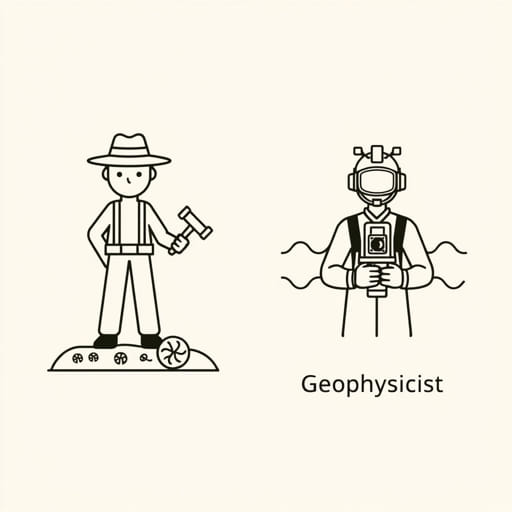
The Earth is a complex and dynamic planet, composed of layers, minerals, rocks, and a variety of physical processes that shape its surface and interior. Understanding this complexity requires expertise in different scientific disciplines, particularly geology and geophysics. While both fields study the Earth, their focus, methods, and applications differ significantly. Knowing the difference between a geologist and a geophysicist is essential for appreciating how scientists explore our planet, predict natural hazards, and locate valuable resources. Both professions play vital roles in environmental research, resource management, and understanding Earth’s evolution.
Defining a Geologist
A geologist is a scientist who studies the solid Earth, its materials, and the processes that shape it over time. Geologists examine rocks, minerals, fossils, and landforms to understand Earth’s history and structure. They analyze geological formations to interpret events such as volcanic eruptions, earthquakes, and mountain formation. Geology combines fieldwork, laboratory analysis, and mapping techniques to study the physical and chemical properties of Earth’s crust.
Key Responsibilities of a Geologist
- Mapping rock formations and geological structures in the field.
- Analyzing rock and mineral samples to determine composition and age.
- Studying fossils to understand the evolution of life on Earth.
- Assessing natural hazards such as landslides, earthquakes, and volcanoes.
- Locating and evaluating natural resources like minerals, oil, and groundwater.
Geologists may specialize in areas such as mineralogy, petrology, paleontology, or environmental geology. Their work is often hands-on and field-based, requiring careful observation, sample collection, and interpretation of Earth’s physical features. By understanding geological processes, geologists contribute to resource management, environmental protection, and disaster risk reduction.
Defining a Geophysicist
A geophysicist studies the physical properties and processes of the Earth using principles of physics and mathematics. While geologists often examine visible rocks and structures, geophysicists probe beneath the surface to understand Earth’s interior. They analyze seismic waves, gravitational and magnetic fields, and heat flow to study phenomena such as earthquakes, volcanic activity, and plate tectonics. Geophysics bridges the gap between surface observations and deep-Earth processes, providing critical insights into Earth’s composition and dynamics.
Key Responsibilities of a Geophysicist
- Using seismic surveys to study Earth’s interior and locate resources.
- Measuring magnetic, gravitational, and electrical properties of rocks.
- Modeling Earth’s physical processes using computer simulations.
- Analyzing data to predict earthquakes, volcanic eruptions, or tsunamis.
- Collaborating with geologists, engineers, and environmental scientists for applied research.
Geophysicists often work in research institutions, oil and gas companies, and environmental consulting firms. Their focus is more on measurements, mathematical modeling, and interpreting data from instruments rather than direct observation of rocks and minerals. By understanding the physical behavior of Earth materials, geophysicists can predict natural phenomena and assist in the exploration of energy resources.
Fieldwork vs. Instrumentation
One of the most noticeable differences between geologists and geophysicists is their approach to studying Earth. Geologists typically conduct extensive fieldwork, examining outcrops, rock formations, and geological features. They rely on mapping, sampling, and visual analysis to interpret Earth’s history and structure. In contrast, geophysicists often work with instruments to measure physical properties of rocks and the subsurface. They may use ground-penetrating radar, magnetometers, seismographs, and other advanced technology to gather data without directly exposing themselves to the rocks they study.
Focus Areas and Applications
Geologists focus on understanding the composition, formation, and evolution of Earth’s solid materials. They interpret geological events in terms of time, structure, and process. This knowledge is crucial for identifying mineral deposits, understanding paleoenvironments, and assessing geological hazards. Applications of geology include mining, petroleum exploration, environmental remediation, and land-use planning.
Geophysicists focus on the physical principles underlying Earth’s processes. They apply physics, mathematics, and computer modeling to understand phenomena such as seismic activity, plate tectonics, and the Earth’s magnetic field. Geophysical research is applied in earthquake prediction, oil and gas exploration, groundwater assessment, and monitoring volcanic activity. While geologists identify the what and where of Earth materials, geophysicists often determine the how and why behind their movement and behavior.
Education and Skills Required
Becoming a geologist generally requires a bachelor’s degree in geology or earth sciences, followed by specialized graduate studies depending on the field of interest. Essential skills include observation, analytical thinking, field mapping, and knowledge of mineralogy and petrology. Geologists also need to understand stratigraphy, structural geology, and geochemical processes.
Geophysicists typically pursue a degree in geophysics, physics, or applied mathematics. Graduate education often focuses on seismology, magnetics, computational modeling, and geophysical survey techniques. Skills in mathematics, data analysis, programming, and instrumentation are critical. While both careers require a strong foundation in earth sciences, geophysicists lean more heavily on quantitative and technical skills.
Collaboration Between Geologists and Geophysicists
Despite their differences, geologists and geophysicists often collaborate closely. Geologists provide critical information about surface rocks and formations, which helps geophysicists interpret subsurface data. For example, in oil exploration, geologists identify promising rock formations, while geophysicists use seismic surveys to map these structures in detail. Similarly, in earthquake studies, geologists map fault lines, while geophysicists analyze stress and wave propagation to predict seismic risk. This interdisciplinary collaboration enhances accuracy and leads to a more comprehensive understanding of Earth’s systems.
Career Opportunities and Industries
Geologists find employment in a wide range of sectors, including mining, environmental consulting, government agencies, and academic research. They may work on projects involving mineral exploration, groundwater assessment, environmental impact studies, and natural hazard evaluation. Their field expertise is highly valued in industries that require knowledge of Earth’s surface and materials.
Geophysicists are often employed in oil and gas exploration, environmental monitoring, geotechnical engineering, and research institutions. They are crucial in projects that involve subsurface investigation, earthquake prediction, and geophysical surveys for resource extraction. Their analytical and technical expertise allows them to tackle complex problems related to Earth’s physical processes.
while geologists and geophysicists both study the Earth, their approaches, focus areas, and methodologies are distinct. Geologists concentrate on observing and analyzing rocks, minerals, and landforms to understand Earth’s history and structure. Geophysicists investigate the physical properties and underlying processes of the Earth, often using instruments and mathematical models. Both professions complement each other, working together to provide a holistic understanding of our planet. Recognizing the difference between a geologist and a geophysicist highlights the diverse skills and perspectives required to explore, protect, and utilize Earth’s resources effectively.