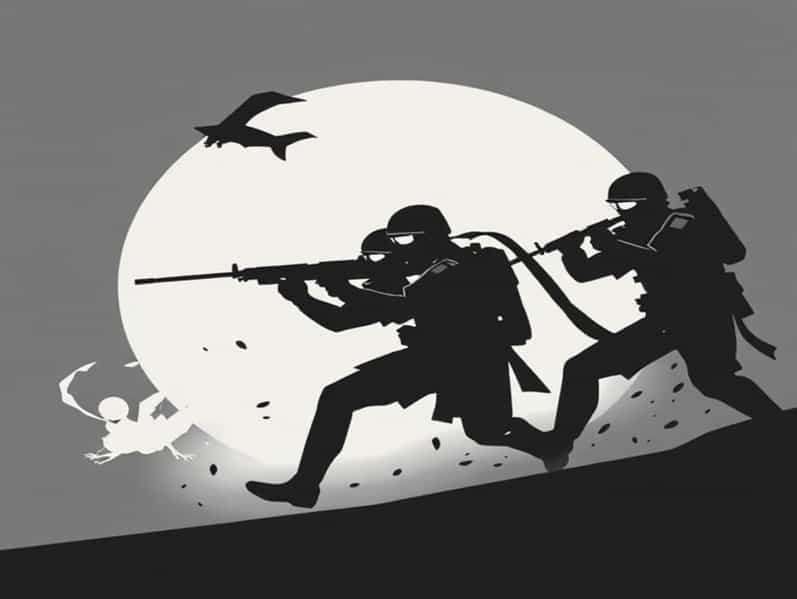
The Battle of Ia Drang is remembered as one of the most intense and historically significant battles of the Vietnam War. It marked the first major engagement between the United States Army and the North Vietnamese Army (NVA) and demonstrated how dramatically war had changed in the mid-20th century. The conflict combined modern air mobility, jungle terrain, and close-quarter combat, resulting in both strategic insight and devastating losses. Understanding this battle reveals the complexities, tactics, and emotional strain that defined the Vietnam War era.
Background of the Ia Drang Valley
Ia Drang Valley is located in the Central Highlands of Vietnam, a region covered in thick jungle, tall grass, and rugged mountains. The area served as a key strategic point for both American and North Vietnamese military forces. For the North Vietnamese, the valley was part of a network of supply routes and hidden encampments. For the United States, targeting the valley was an attempt to disrupt enemy movement and gain control of the region.
By late 1965, U.S. military strategy had begun shifting toward using helicopters for rapid deployment, allowing soldiers to move quickly and respond to enemy engagements with greater flexibility. The Battle of Ia Drang would be the first major test of this approach, which would later become a hallmark of U.S. operations in Vietnam.
The Combatants
The battle was fought between the U.S. Army’s 1st Cavalry Division (Airmobile) and the North Vietnamese Army’s 66th Regiment, along with supporting units. The U.S. forces were led by Lieutenant Colonel Harold G. Moore, while the North Vietnamese forces were directed by experienced officers who were familiar with the terrain and guerrilla warfare strategies.
U.S. Strengths
- Helicopter mobility for rapid insertion and evacuation
- Advanced communication equipment
- Strong artillery and air support
North Vietnamese Strengths
- Superior knowledge of the terrain
- Effective use of camouflage and hidden movement
- Highly motivated and disciplined infantry
Landing at LZ X-Ray
The first major engagement took place at a clearing designated as Landing Zone X-Ray on November 14, 1965. U.S. troops were inserted by helicopter and quickly met resistance from North Vietnamese soldiers hidden in the surrounding vegetation. What began as a tactical movement soon escalated into a fierce, sustained battle.
Colonel Moore’s leadership and calm under pressure became a defining element of the struggle. He positioned his troops defensively, maintained communication with air support, and ensured that wounded soldiers were evacuated whenever possible. The close nature of the fighting meant that airstrikes and artillery had to be carefully coordinated to avoid friendly fire.
Intense Fighting and Close-Quarter Combat
The jungle environment made visibility difficult and limited long-range engagement. Both sides exchanged gunfire at extremely close distances, and the chaos of battle often created confusion. Soldiers experienced exhaustion, fear, and the overwhelming pressure of constant attack.
Helicopter Support
One of the defining features of the Battle of Ia Drang was the use of helicopters. Helicopters brought reinforcements, evacuated the wounded, and supplied ammunition. They also called in airstrikes that proved crucial in preventing the U.S. line from being overrun.
A well-known figure in the battle was Major Bruce Crandall, a helicopter pilot who flew multiple dangerous evacuation and resupply missions under heavy enemy fire. His efforts later became recognized as acts of great bravery.
The Shift to LZ Albany
After heavy fighting at LZ X-Ray, U.S. forces began to move toward LZ Albany for extraction. However, during this movement, the situation changed drastically. The troops became spread out, and communication broke down. The North Vietnamese launched a coordinated ambush, resulting in one of the deadliest encounters of the battle.
The ambush at LZ Albany caused significant American casualties and demonstrated the North Vietnamese Army’s ability to exploit weaknesses and use terrain advantage effectively.
Casualties and Losses
The Battle of Ia Drang lasted three days and resulted in high casualties on both sides. Estimates vary, but it is generally agreed that
- Approximately 234 American soldiers were killed
- More than 1,000 North Vietnamese soldiers died
Although the U.S. forces held their ground and inflicted heavy losses, the battle also revealed how determined and capable the North Vietnamese Army was. The conflict demonstrated that technological advantage alone would not guarantee a swift or easy victory.
Strategic and Psychological Impact
The Battle of Ia Drang had far-reaching consequences. For the United States, it confirmed that helicopter-based mobility could be effective, but also highlighted the danger of underestimating the enemy. For the North Vietnamese, the battle became proof that disciplined, well-prepared forces could challenge American military might.
Both sides learned valuable tactical lessons
- The U.S. learned that maintaining unit cohesion in the jungle was critical
- The North Vietnamese became convinced that prolonged, mobile warfare could gradually wear down American resolve
Cultural Memory and Legacy
The story of the battle later became widely known through books and films, most notably We Were Soldiers Once…. and Young, co-authored by General Harold Moore and journalist Joseph Galloway, who had been present during the battle. This account emphasized not only the strategic complexity of the engagement but also the personal experiences of the soldiers who fought there.
The Battle of Ia Drang remains an important event for military historians, students, and veterans. It symbolizes the beginning of a long and difficult conflict that would challenge both nations politically, emotionally, and militarily.
The Battle of Ia Drang stands as a powerful example of courage, strategy, sacrifice, and the harsh realities of war. It marked a turning point in military tactics, introduced widespread use of air mobility, and highlighted the strength and determination of both the U.S. Army and the North Vietnamese forces. While the battle did not determine the final outcome of the Vietnam War, it left a lasting legacy that continues to be studied and remembered today.