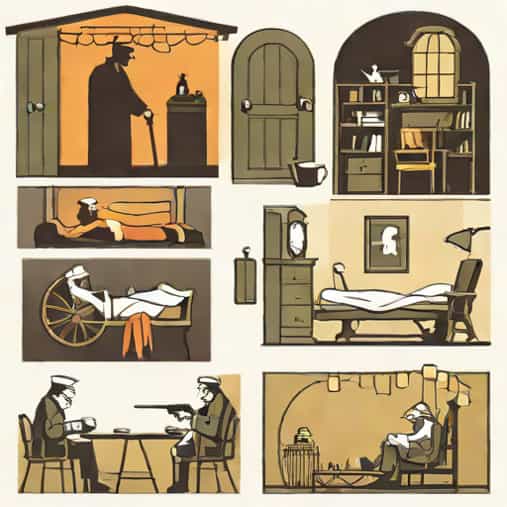
The Murders in the Rue Morgue by Edgar Allan Poe is often celebrated as the first modern detective story, introducing readers to the brilliant detective C. Auguste Dupin. This short story, first published in 1841, combines elements of mystery, analytical reasoning, and horror. Its intricate plot revolves around a gruesome double murder in Paris that leaves authorities baffled. From the very beginning, Poe challenges readers to engage in careful observation and logical deduction. Analyzing the murders in the Rue Morgue reveals not only the ingenuity of Poe’s storytelling but also the foundations of the detective fiction genre, emphasizing the importance of intellect over brute force in solving complex crimes.
The Context of the Story
Set in 19th-century Paris, the story captures the atmosphere of the city with its narrow streets, crowded neighborhoods, and bustling social life. Poe uses this setting to create a vivid backdrop for the mysterious events that unfold. The Rue Morgue itself, where the murders occur, is depicted as a typical urban dwelling of the time, yet it becomes the center of horror and intrigue. The story reflects both societal fascination with crime and the period’s growing interest in scientific reasoning, which Poe incorporates through his protagonist, Dupin.
The Victims and the Crime Scene
The victims, Madame L’Espanaye and her daughter, are found brutally murdered in their apartment. The scene is chaotic and confusing, filled with puzzling details that confound the police. Windows are locked from the inside, furniture is overturned, and the bodies are mutilated in ways that seem impossible for any human assailant. This meticulous description of the crime scene invites readers to participate in the investigation and challenges them to apply logic, observation, and inference, much like Dupin does throughout the story.
C. Auguste Dupin The Analytical Detective
One of the most significant contributions of The Murders in the Rue Morgue is the character of C. Auguste Dupin. Unlike typical detectives of later fiction, Dupin relies entirely on intellectual analysis rather than physical prowess or intuition. He examines the crime scene, considers the witness accounts, and notices details that others overlook. Dupin’s method of ratiocination, or logical reasoning, forms the basis of his investigative approach. He dissects evidence, identifies inconsistencies, and constructs hypotheses that eventually lead him to the truth.
Dupin’s Methods and Logic
Dupin demonstrates several key techniques in solving the Rue Morgue murders
- ObservationHe pays close attention to minute details, such as the orientation of furniture, the nature of the wounds, and the strange language described by witnesses.
- Analysis of Witness StatementsDupin critically evaluates the accounts given by neighbors, distinguishing between useful information and irrelevant noise.
- Logical DeductionHe constructs a sequence of events that explains the impossible elements of the crime, such as the locked-room mystery and the violent nature of the attack.
- Creative Problem SolvingDupin considers unconventional possibilities that the police dismiss, leading to the eventual revelation of the true perpetrator.
The Locked-Room Mystery
One of the central puzzles in The Murders in the Rue Morgue is the locked-room aspect. The windows and doors are securely closed, leaving no apparent way for the murderer to enter or exit. Poe uses this scenario to heighten tension and challenge readers’ expectations. Dupin’s investigation reveals that the solution lies in understanding the physical capabilities of the assailant, rather than assuming traditional human limitations. This concept would become a hallmark of later detective fiction, emphasizing cleverness and ingenuity over straightforward force.
The Role of Eyewitness Accounts
Eyewitness testimony plays a significant role in the narrative, though it is often unreliable. Witnesses report hearing a strange voice speaking in an unrecognizable language, further complicating the investigation. Dupin carefully analyzes these accounts, noting that perception can be distorted by fear, stress, or misunderstanding. By interpreting the witnesses’ statements correctly, Dupin uncovers clues that guide him to the surprising conclusion. This emphasis on evaluating evidence critically reflects Poe’s belief in the power of intellect to uncover truth, even in seemingly impossible situations.
The Perpetrator and the Resolution
Without revealing excessive plot details, the resolution of the murders is both unexpected and ingenious. The culprit turns out to be an unusual and non-human assailant, which explains the extraordinary violence and the impossibility of the locked-room scenario. Poe’s choice to reveal a non-human perpetrator highlights the limits of conventional assumptions and emphasizes the importance of reasoning beyond the ordinary. Dupin’s solution satisfies both the logical and dramatic needs of the story, providing closure while showcasing his extraordinary analytical abilities.
The Story’s Influence on Detective Fiction
The Murders in the Rue Morgue established many conventions that would define the detective genre. These include
- The brilliant, analytical detective who relies on intellect over instinct.
- The use of a locked-room or seemingly impossible crime to challenge the detective and the reader.
- The careful description of evidence and attention to detail as central to solving the mystery.
- The contrast between the detective and official law enforcement, highlighting superior reasoning skills.
Poe’s story inspired countless authors, from Arthur Conan Doyle to Agatha Christie, cementing the importance of analytical deduction in detective narratives.
Thematic Analysis
Beyond the mechanics of the mystery, the story explores themes of logic, human perception, and the limits of understanding. It questions the reliability of appearances and demonstrates that truth can often be hidden behind seemingly impossible circumstances. The murders themselves serve as a vehicle for exploring these ideas, as the shocking violence forces both the characters and readers to confront the unexpected and the irrational. Poe’s use of horror elements enhances the tension, while Dupin’s rational approach offers a counterbalance that celebrates human intellect and analytical thinking.
Analyzing the murders in the Rue Morgue reveals the genius of Edgar Allan Poe’s storytelling. Through meticulous description, a perplexing crime, and the introduction of a methodical detective, Poe created a narrative that remains influential in both mystery and detective fiction. The locked-room puzzle, the careful evaluation of evidence, and the ultimate revelation of the unconventional culprit showcase the power of analytical reasoning over assumption and conjecture. The Murders in the Rue Morgue continues to captivate readers with its blend of horror, mystery, and intellect, demonstrating why Poe is rightly considered the father of the modern detective story.