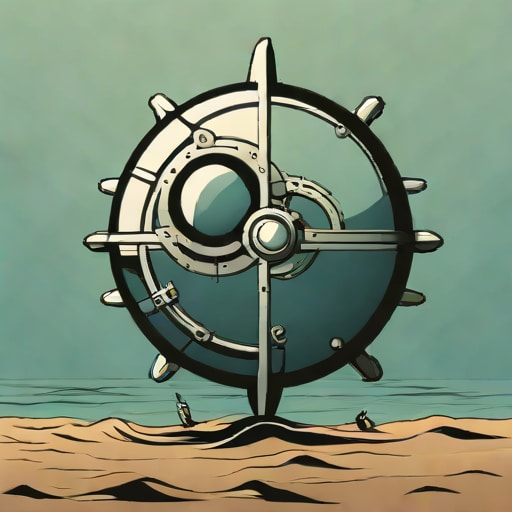
The ocean has always been a source of wonder and fear for humankind, with its vast, uncharted depths hiding mysteries that challenge our imagination. One concept that has captured the intersection of science and horror is the idea of a bathysphere encountering an eldritch terror. Bathyspheres, deep-sea submersibles developed in the early 20th century, allowed humans to descend into parts of the ocean previously unreachable. Meanwhile, the notion of eldritch terror, often drawn from the cosmic horror literature of H.P. Lovecraft and others, represents an unknowable, incomprehensible, and terrifying presence. The idea of combining these two evokes both the scientific thrill of exploration and the existential dread of confronting something utterly alien, creating a narrative where the depths of the ocean become a stage for horror beyond human comprehension.
The History and Design of Bathyspheres
Bathyspheres are spherical submersibles designed to withstand extreme oceanic pressures. Developed in the 1930s by William Beebe and Otis Barton, these vessels were made of steel and equipped with thick windows to observe the deep sea. The spherical shape evenly distributes pressure, allowing these vessels to descend to remarkable depths. Beebe’s early explorations into the depths of the Atlantic and Pacific Oceans provided some of the first human accounts of deep-sea life, revealing strange and previously unknown species. The bathysphere, therefore, represents human ingenuity, curiosity, and the desire to explore places where life exists in forms that challenge our conventional understanding.
Structural Features
- Steel or reinforced metal shell designed to resist crushing pressures.
- Thick, reinforced portholes for observation.
- Basic communication lines to the surface for safety and coordination.
- Limited internal space, often only fitting two or three occupants.
The bathysphere’s limitations-restricted mobility, confined quarters, and dependence on surface support-highlight the vulnerability of humans when exploring extreme environments. This vulnerability makes the concept of encountering an eldritch terror particularly terrifying, as there is no easy escape from the crushing depths of the ocean.
Understanding Eldritch Terror
Eldritch terror is a term rooted in the tradition of cosmic horror. Unlike traditional monsters, eldritch horrors are not necessarily evil in a moral sense; instead, they are incomprehensible, alien entities whose mere presence can drive humans to madness. These beings defy natural laws, logic, and human understanding. Encounters with eldritch terror often emphasize the insignificance of humanity in the grand scale of the cosmos, creating psychological horror that is as potent as any physical threat. Combining this with the isolation of a bathysphere in the deep ocean amplifies the dread, as the ocean itself is already an alien environment where the rules of human experience are challenged.
Characteristics of Eldritch Entities
- Unknowable forms and structures that defy human anatomy.
- Indescribable motions or behaviors that appear chaotic and alien.
- Psychological effects on observers, such as fear, confusion, and insanity.
- Immense size or power, often dwarfing human-scale perception.
These characteristics make eldritch terror a uniquely effective form of horror when paired with deep-sea exploration. The bathysphere acts as both a window into the alien environment of the ocean and a confining vessel that isolates humans from safety, heightening the stakes.
The Deep Sea as a Stage for Horror
The ocean depths provide a natural backdrop for the concept of eldritch terror. Sunlight does not penetrate these regions, leaving explorers in near-total darkness, surrounded by water that amplifies sound and muffles familiar cues. Pressure increases dramatically with depth, and temperatures drop near freezing. Many deep-sea creatures possess bioluminescence or other adaptations that appear bizarre or frightening to human eyes. The combination of darkness, isolation, and alien life creates a setting where human perception is limited, and fear is intensified.
Psychological Effects of the Deep Sea
- Claustrophobia from confined spaces in submersibles.
- Anxiety stemming from limited communication with the surface.
- Heightened sensitivity to unfamiliar sounds, shadows, or movements.
- Imagination filling gaps in perception with possible threats.
When an eldritch entity is imagined within this environment, the effect is multiplied. The isolation and extreme conditions of deep-sea exploration create an atmosphere where rational explanation seems impossible, allowing fear to thrive.
Fictional Accounts and Literary Inspirations
The concept of bathyspheres encountering eldritch horrors has appeared in both literature and media. H.P. Lovecraft’s works frequently explore the idea of humans confronting incomprehensible, ancient beings, often located in the ocean’s depths. Stories like The Call of Cthulhu describe immense, sleeping entities beneath the sea, whose awakening threatens sanity and civilization itself. Modern adaptations in film, video games, and novels continue to explore this intersection of deep-sea exploration and cosmic horror, demonstrating its enduring appeal.
Why This Combination Works
- The bathysphere symbolizes human curiosity and technological advancement.
- The eldritch terror represents the unknowable and uncontrollable forces of the universe.
- The ocean amplifies isolation, vulnerability, and sensory deprivation.
- The narrative tension arises from the clash between human limitations and incomprehensible entities.
Scientific Perspectives and Speculation
While eldritch terror remains fictional, deep-sea exploration continues to reveal astonishing and sometimes unsettling creatures. Giant squids, bioluminescent fish, and deep-sea jellyfish demonstrate the ocean’s potential for life forms that seem alien to human experience. Some scientists speculate that undiscovered species in the abyss could challenge existing biological classifications. Although the extreme horrors described in fiction are exaggerated, the unknown nature of the deep sea allows the imagination to fill in terrifying possibilities, blurring the line between science and horror.
Real-Life Deep-Sea Discoveries
- Giant squids reaching lengths of over 40 feet.
- Anglerfish with grotesque bioluminescent lures.
- Hydrothermal vent communities with unique chemosynthetic life forms.
- Unclassified microorganisms surviving extreme pressures and temperatures.
These discoveries illustrate that the ocean is an environment where life adapts in ways that can appear fantastical or alien, providing a foundation for the imagination that creates eldritch horror narratives.
The Allure of Bathysphere Eldritch Horror
The combination of bathyspheres and eldritch terror captures something fundamental about human psychology the simultaneous desire to explore and fear the unknown. Deep-sea exploration represents the triumph of human ingenuity and curiosity, while the concept of eldritch terror reminds us of our limitations and the possibility that some forces may forever remain beyond comprehension. This duality resonates in literature, film, and games because it taps into universal fears of isolation, insignificance, and encountering the unimaginable.
Lessons and Themes
- The limits of human knowledge and technology.
- The vastness and unpredictability of nature.
- The fragility of the human mind when confronted with the incomprehensible.
- The thrill and danger of exploring the unknown.
The imagery of a bathysphere encountering an eldritch terror combines scientific exploration with cosmic horror, creating a scenario that is both thrilling and terrifying. While eldritch horrors remain a product of imagination, the deep sea is real, mysterious, and full of life that challenges our understanding. Bathyspheres represent humanity’s courage to confront these unknowns, while the concept of eldritch terror reminds us of our limits and the possibilities that lie in the uncharted depths. Together, they create a compelling narrative about curiosity, fear, and the unknown, demonstrating why the ocean continues to captivate and terrify human imagination.