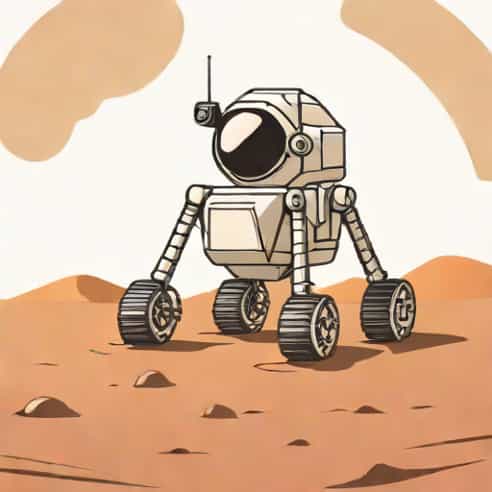
Curiosity, NASA’s Mars rover, continues to be one of the most remarkable engineering achievements in space exploration. Launched in 2011 and landing successfully on the Martian surface in August 2012, the rover has far exceeded its original two-year mission plan. Many people often wonder is Curiosity still on Mars and functioning after all these years? The answer is yes – Curiosity is still exploring Mars, sending valuable data and breathtaking images back to Earth more than a decade after its arrival. Its continued operation is a testament to the resilience of modern space technology and the dedication of the scientists and engineers who manage it.
The Purpose of Curiosity’s Mission
Curiosity’s primary mission is to study Mars’s geology and climate to determine if the planet ever had the right environmental conditions to support microbial life. The rover is part of NASA’s Mars Science Laboratory (MSL) project, and it was designed to explore the Gale Crater – a massive basin that likely once held water. By studying the composition of rocks, soil, and atmosphere, Curiosity helps scientists piece together the planet’s ancient history and understand its potential for habitability.
Unlike earlier Mars rovers such as Spirit and Opportunity, which focused on surface exploration, Curiosity carries a suite of advanced scientific instruments capable of analyzing chemical compositions directly on-site. Its findings have reshaped our understanding of Mars as a dynamic planet that once may have been far more Earth-like than it appears today.
How Curiosity Survives on Mars
Curiosity was designed with remarkable endurance in mind. Unlike solar-powered rovers, it runs on a radioisotope thermoelectric generator (RTG), which converts heat from the decay of plutonium-238 into electricity. This power source gives Curiosity a long lifespan, allowing it to continue functioning despite the harsh Martian environment. The RTG provides both power and warmth, keeping the rover’s instruments operational even during freezing Martian nights and dust storms.
Because of this power system, Curiosity doesn’t depend on sunlight like the later Perseverance rover or the InSight lander. This independence allows it to continue its mission through all Martian seasons without the risk of shutting down due to dust-covered solar panels – a problem that ended missions like Opportunity’s in 2018.
Recent Updates Is Curiosity Still Active?
As of today, Curiosity is still fully operational and continues to explore the surface of Mars. The rover is currently investigating a region known as Mount Sharp (officially called Aeolis Mons), a towering mountain located in the center of Gale Crater. Curiosity has been climbing the mountain’s slopes, analyzing layered rock formations that reveal the history of water and climate changes on Mars.
Each year, NASA’s Jet Propulsion Laboratory (JPL) provides updates confirming that Curiosity is healthy and productive. It still uses its suite of scientific tools – including cameras, spectrometers, and drills – to study the planet’s surface. Despite some wear and tear on its wheels and robotic arm, the rover continues to operate impressively after more than 13 years on the Martian surface.
Communication with Earth
Curiosity communicates with Earth through orbiters that relay its data back to mission control. The rover sends images, scientific measurements, and status reports daily. Engineers at JPL regularly upload new commands, telling Curiosity where to drive, what rocks to analyze, and when to capture photographs. This two-way communication keeps the mission active and productive, even across the vast distance of more than 225 million kilometers.
Scientific Achievements of Curiosity
Curiosity’s work on Mars has led to groundbreaking discoveries. Some of its most significant achievements include
- Evidence of Ancient WaterCuriosity found mineral veins and sedimentary layers that indicate rivers and lakes once flowed through Gale Crater.
- Organic Molecules DetectionThe rover identified complex organic compounds, suggesting that the building blocks of life may have existed on ancient Mars.
- Seasonal Methane VariationsCuriosity detected fluctuating levels of methane in the Martian atmosphere, a finding that remains one of the most intriguing mysteries about the planet’s chemistry.
- Radiation MeasurementsThe rover measured radiation levels on Mars’s surface, providing critical data for future human missions.
- Geological InsightsCuriosity’s study of Mount Sharp’s layers has helped scientists understand how the Martian climate transitioned from warm and wet to cold and dry.
These discoveries collectively strengthen the case that Mars once had conditions suitable for microbial life, even if none currently exists.
Challenges Faced by Curiosity
Operating on Mars is far from easy. Over the years, Curiosity has faced several mechanical and environmental challenges. One recurring issue has been wear and tear on its aluminum wheels, caused by the sharp, rocky terrain. Engineers have since adjusted the rover’s driving routes and speed to reduce further damage.
Another challenge involves its robotic drill. At one point, mechanical problems temporarily halted drilling operations, but the JPL team devised new software techniques that allowed Curiosity to continue sampling rocks in a different way. These adaptations showcase the creativity and persistence of mission engineers, who continue to find solutions that extend the rover’s life far beyond expectations.
How Curiosity Compares to Other Mars Rovers
Curiosity is part of a long lineage of NASA Mars rovers, each one building upon the success of its predecessors. Spirit and Opportunity paved the way for long-distance exploration, while Curiosity introduced a nuclear power source and advanced laboratory instruments. The newer Perseverance rover, which landed in 2021, uses many of the same technologies but with additional tools for collecting rock samples and testing systems for future human exploration.
Despite newer missions, Curiosity remains a vital part of NASA’s ongoing Mars research program. Its extended mission continues to provide valuable long-term data on environmental changes, soil composition, and weather patterns – information that newer rovers can compare with observations from other regions of the planet.
What Curiosity Has Taught Us About Mars
Through its many years on Mars, Curiosity has transformed our understanding of the Red Planet. Before its arrival, scientists suspected that water once flowed on Mars, but they lacked solid evidence. Curiosity confirmed that Gale Crater once contained a lake and discovered minerals that form only in the presence of water. These findings suggest that ancient Mars was not just wet but also potentially habitable.
The rover’s detection of organic molecules further deepened scientific curiosity about Mars’s biological potential. While these molecules do not prove the existence of life, they indicate that the chemical ingredients necessary for life were present at some point in the planet’s history.
The Future of Curiosity
Curiosity continues to climb Mount Sharp, studying rock formations that become increasingly ancient as it ascends. Each layer represents a different era in Martian history, allowing scientists to reconstruct how the planet’s environment evolved over billions of years. Although it faces natural wear over time, NASA plans to operate Curiosity as long as it remains functional and scientifically valuable.
Future updates will likely focus on comparing data from Curiosity and Perseverance, offering a broader view of Mars’s past. Together, these missions are paving the way for eventual human exploration and the search for past or present life on the planet.
So, is Curiosity still on Mars? Absolutely – and it’s still going strong. More than a decade after landing, the rover continues to explore, analyze, and inspire. Its discoveries have changed how we view Mars, turning it from a barren world into a place of fascinating geological and chemical complexity. Curiosity’s success proves that even on a distant planet, human ingenuity can thrive, pushing the boundaries of what’s possible in space exploration. As long as it keeps rolling across the dusty red terrain, Curiosity will remain a symbol of our quest to understand the universe – one rock sample at a time.