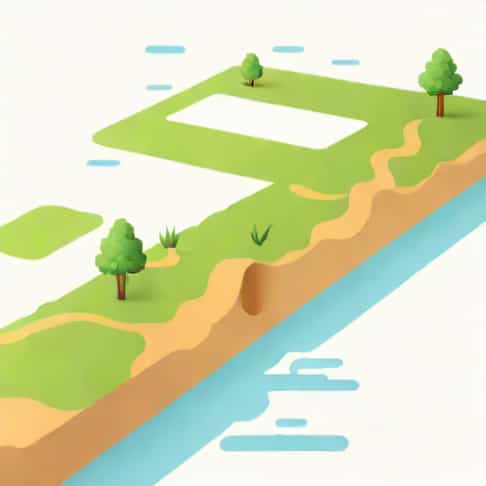
Levees are an essential feature of river landscapes and flood management systems, playing a crucial role in protecting human settlements and agricultural land from flooding. Understanding the formation of a levee involves examining both natural and artificial processes that contribute to its development. Levees are not only physical barriers but also indicators of the interaction between water, sediment, and the surrounding environment. By exploring how levees form, their structure, and their importance, one can appreciate their role in shaping riverine landscapes and mitigating flood risks.
Definition and Purpose of a Levee
A levee is a raised embankment constructed along the banks of a river or water body to prevent flooding of adjacent land. The term is derived from the French word lever, meaning to raise, which reflects the levee’s function as a raised barrier. Levees can be naturally occurring or artificially constructed, and they vary in size, shape, and material composition.
The primary purpose of a levee is to contain the river’s flow within its channel during periods of high water, thereby protecting nearby communities, farmland, and infrastructure from inundation.
Natural Formation of Levees
Natural levees are formed over time by the deposition of sediments during repeated flooding events. These processes involve the interaction of water velocity, sediment load, and the river’s overflow patterns.
Step One Floodplain Overflow
When a river exceeds its banks during a flood, water spills onto the adjacent floodplain. As the water spreads out, its velocity decreases, reducing the carrying capacity for sediments.
- High-velocity water within the river channel transports sand, silt, and clay downstream.
- As the water exits the channel, the reduction in speed causes sediments to settle out.
Step Two Sediment Deposition
The coarsest sediments, such as sand and fine gravel, are deposited closest to the riverbanks, while finer ptopics like silt and clay are carried farther onto the floodplain. Over repeated flooding events, these deposits accumulate along the riverbanks, gradually forming elevated ridges known as natural levees.
- Sand and gravel form the initial raised embankments.
- Silt and clay extend the levee into the floodplain, creating a gentle slope away from the river.
Step Three Vegetation and Soil Stabilization
Vegetation often grows on the newly formed levee, stabilizing the soil and reducing erosion. The roots of plants bind the sediments together, making the levee more resistant to the river’s force during subsequent floods.
- Grass and shrubs prevent surface erosion.
- Tree roots provide deeper stabilization for the embankment.
Artificial Formation of Levees
While natural levees form over long periods, artificial levees are engineered to provide immediate flood protection. Human-constructed levees are common along major rivers and in areas prone to frequent flooding.
Step One Site Assessment and Planning
The first stage in constructing an artificial levee is assessing the site. Engineers examine river flow patterns, flood frequency, soil type, and existing infrastructure to determine the optimal location and dimensions of the levee.
- Hydrological studies to estimate flood levels.
- Soil analysis to ensure stability and drainage capability.
- Planning for levee height, width, and slope.
Step Two Material Selection and Placement
Artificial levees are typically made from earth, sand, clay, or rock. The material is placed and compacted in layers to create a strong embankment capable of withstanding floodwaters.
- Clay cores are used to reduce water seepage.
- Outer layers of sand and gravel provide structural support.
- Compaction machinery ensures density and stability.
Step Three Surface Protection and Reinforcement
To prevent erosion from flowing water or wave action, artificial levees are often reinforced with vegetation, rock armoring (riprap), or concrete. These measures prolong the levee’s lifespan and reduce maintenance needs.
- Riprap or stone layers absorb and deflect energy from floodwaters.
- Grass and other vegetation reduce surface erosion and promote soil cohesion.
- Engineered drainage systems prevent waterlogging behind the levee.
Maintenance and Monitoring of Levees
Whether natural or artificial, levees require ongoing monitoring and maintenance. Natural levees may erode over time due to rain, wind, or subsequent flooding, while artificial levees may settle, crack, or be undermined by water seepage.
Regular inspections are necessary to identify weak spots, monitor vegetation health, and repair any damage promptly. Early detection of problems is critical to prevent catastrophic levee failure during major flood events.
Environmental and Ecological Considerations
Levee construction and presence can affect local ecosystems. Natural levees support vegetation and provide habitats for wildlife, but artificial levees may alter floodplain dynamics, restrict water flow, and impact aquatic and terrestrial species.
Modern levee projects often include environmental assessments to balance flood protection with ecological preservation. Some designs incorporate setbacks or overflow areas to maintain natural floodplain functions.
Levees in Flood Management Strategies
Levees are a central component of broader flood management plans. They work in conjunction with reservoirs, floodways, and drainage systems to reduce the risk of flooding and protect human lives and property.
- Levees provide primary containment along rivers prone to overflow.
- Setback levees allow controlled flooding of designated areas to relieve pressure on main channels.
- Integration with urban planning helps minimize flood damage in residential and commercial zones.
The formation of a levee, whether through natural sediment deposition or artificial construction, demonstrates the interplay between water, soil, and human intervention. Natural levees develop gradually through repeated flooding and sediment settlement, while artificial levees are carefully engineered to provide immediate and reliable flood protection. Both types require maintenance, environmental consideration, and integration into comprehensive flood management strategies. Understanding the formation of levees is vital for engineers, environmentalists, and communities seeking to manage flood risks and protect lives and property effectively. By studying the processes and principles behind levee formation, we gain insight into how landscapes are shaped and how human ingenuity can mitigate natural hazards.