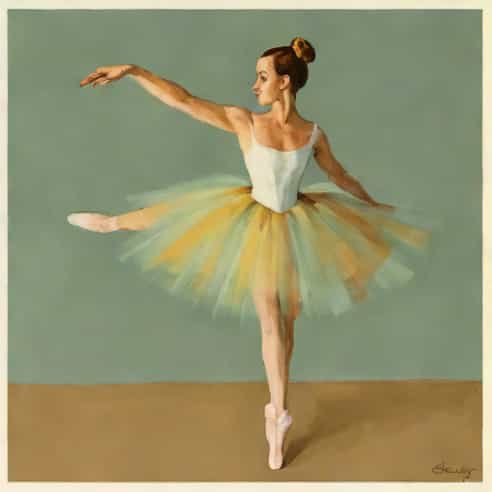
Edgar Degas, one of the most influential artists of the 19th century, is renowned for his captivating ballerina paintings. These works capture the grace, discipline, and fleeting beauty of ballet, highlighting Degas’ unique ability to blend realism with impressionistic techniques. His fascination with dancers was not simply about their aesthetic appeal; he sought to explore movement, posture, and the intense effort behind the seemingly effortless art of ballet. Through meticulous observation, Degas produced paintings that reveal both the elegance and the rigorous discipline of dancers, offering viewers a glimpse into a world often hidden behind the curtain of performance.
The Artistic Journey of Edgar Degas
Born in Paris in 1834, Edgar Degas initially trained in classical art, studying at the École des Beaux-Arts under Louis Lamothe. His early work focused on historical and religious subjects, but over time, he gravitated towards modern life, particularly scenes of urban leisure. Degas’ exposure to the Paris Opera Ballet sparked a lifelong fascination with dancers, a subject he would revisit for decades. Unlike other artists who idealized dancers, Degas was interested in capturing their human side-their sweat, strain, and quiet moments of preparation.
Techniques and Style
Degas’ ballerina paintings demonstrate a mastery of pastel, oil painting, and drawing. His style combined elements of realism with impressionist influences, particularly in his use of light, movement, and color. Degas often employed unusual perspectives and cropped compositions, which created a sense of spontaneity and intimacy. By observing dancers during rehearsals and backstage moments, he captured fleeting gestures that convey both energy and subtle emotion.
- Use of pastels for soft, luminous effects.
- Oil paintings with layered textures to depict movement.
- Asymmetrical compositions and unusual viewpoints.
- Attention to anatomy, posture, and human effort.
Major Themes in Degas’ Ballerina Paintings
Degas’ work frequently focuses on themes that extend beyond the surface beauty of ballet. He explored tension between discipline and grace, the contrast between public performance and private preparation, and the interplay of light and shadow on the human form. His paintings reveal the hard work behind the elegance, emphasizing the physicality, repetition, and concentration required of dancers.
Rehearsal Scenes
Many of Degas’ ballerina paintings depict dancers in rehearsal rather than on stage. Works such as The Dance Class and Dancers Practicing at the Barre capture moments of instruction, stretching, and practice. These paintings reveal the repetitive training and physical endurance necessary for ballet, providing a candid view of the dancers’ world.
Backstage and Candid Moments
Degas also painted dancers preparing behind the scenes, applying makeup or adjusting costumes. These intimate moments provide insight into the human side of ballet, where concentration, fatigue, and anticipation are apparent. Paintings such as Dancer Adjusting Her Slipper highlight the vulnerability and individuality of each performer, contrasting the polished perfection seen on stage.
Performance and Stage Scenes
Although less frequent, Degas did depict dancers during actual performances. In these works, he explored lighting, movement, and the dynamic interaction between performers. The stage became a setting for experimentation with perspective and composition, showcasing the grace of the dancers while maintaining a realistic representation of their effort.
Iconic Ballerina Paintings
Several of Degas’ works have become iconic representations of ballet and 19th-century Parisian culture. Some notable examples include
- The Dance Class (1874)Captures dancers at the barre under the guidance of a teacher, emphasizing structure and movement.
- Dancers Practicing at the Barre (1880)Highlights the precision and repetition involved in training.
- Dancer Adjusting Her Slipper (1875-80)Shows an intimate backstage moment, blending realism with emotional depth.
- Blue Dancers (1890-95)Uses pastel to convey light, motion, and the ephemeral quality of dance.
Impact on Impressionism and Modern Art
Degas’ ballerina paintings contributed significantly to the development of modern art and Impressionism. While he resisted the label of Impressionist, his techniques-particularly the focus on movement, light, and contemporary life-aligned with the movement’s principles. His ability to capture transient moments, unconventional angles, and the human body in motion influenced generations of artists and expanded the scope of figurative painting.
Legacy of Observation and Realism
Degas’ dedication to observing dancers in natural, unstaged environments set a new standard for artistic realism. Unlike purely idealized representations, his works emphasize authenticity and human effort, challenging viewers to appreciate the discipline behind performance. This legacy has inspired both painters and photographers to capture life in its most genuine forms.
Use of Pastel and Mixed Media
Degas’ innovative use of pastels, often combined with ink or paint, allowed him to achieve delicate textures and subtle color shifts. This experimentation influenced future artists in their exploration of mixed media and unconventional techniques, expanding the possibilities of visual storytelling.
Edgar Degas’ ballerina paintings remain timeless masterpieces that reveal the intersection of art, discipline, and human observation. Through meticulous study of dancers’ movements, postures, and intimate moments, Degas created works that combine realism with impressionistic elegance. His paintings celebrate the beauty of ballet while honoring the effort, practice, and dedication behind each performance. Degas’ contribution to art extends beyond the aesthetic, offering insight into the physical and emotional realities of performers. Today, these works continue to captivate audiences, influence contemporary artists, and serve as enduring symbols of the grace, strength, and complexity of human movement.