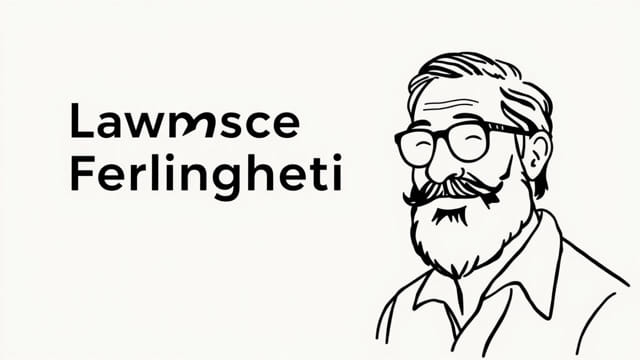
Lawrence Ferlinghetti was a renowned American poet, publisher, painter, and political activist whose life and work played a significant role in shaping American literary and cultural history. As the co-founder of City Lights Booksellers & Publishers in San Francisco, he helped launch the Beat Generation into national prominence and fought against censorship to preserve freedom of speech. Ferlinghetti’s poetry was accessible, politically charged, and deeply rooted in the human experience, often tackling themes of peace, justice, and individuality. His influence spanned decades, and he remained a vital voice in literature and activism well into his later years.
Early Life and Education
Childhood and Family Background
Lawrence Ferlinghetti was born on March 24, 1919, in Yonkers, New York. His early life was marked by hardship. His father died before he was born, and his mother was later institutionalized. As a result, Ferlinghetti spent his early years in foster care and with relatives, including time spent in France. This multilingual, multicultural upbringing shaped his worldview and contributed to his later interest in global literature and ideas.
Academic Journey
Ferlinghetti attended the University of North Carolina at Chapel Hill, where he earned a B.A. in journalism. His education was interrupted by World War II, during which he served in the U.S. Navy. After the war, he studied at Columbia University, earning a master’s degree in literature, and later earned a doctorate from the Sorbonne in Paris. These experiences, both academic and worldly, enriched his literary voice and political consciousness.
City Lights and the Beat Generation
Founding City Lights
In 1953, Ferlinghetti co-founded City Lights Bookstore in San Francisco with Peter D. Martin. It was the first all-paperback bookstore in the United States, and it quickly became a hub for writers, artists, and political thinkers. In 1955, he launched City Lights Publishers, a small press that gave rise to the Pocket Poets Series.
Publishing Allen Ginsberg’s Howl
One of the most pivotal moments in Ferlinghetti’s career was the publication of Allen Ginsberg’s poemHowlin 1956. The poem’s raw depiction of sexuality, drug use, and defiance of conformity led to Ferlinghetti’s arrest on obscenity charges. In a landmark trial, the court ruled in favor of free expression, establishing a major precedent for literary freedom in America. Ferlinghetti emerged as a champion of the First Amendment and a fearless advocate for poets and writers whose voices challenged the mainstream.
Poetic Style and Themes
Accessible and Free-Flowing
Ferlinghetti’s poetry is often characterized by its conversational tone, visual imagery, and political themes. He rejected academic elitism in poetry, choosing instead to write in a way that spoke directly to ordinary people. His poems were meant to be read aloud, often resembling jazz in their rhythm and improvisation. His first book,A Coney Island of the Mind(1958), became one of the most popular poetry collections of the 20th century.
Recurring Motifs
Ferlinghetti’s work often revolved around themes of:
- War and peace
- Urban life and alienation
- Political corruption
- Human rights and justice
- Art and beauty in the modern world
He viewed poetry as a tool for activism, a means of confronting injustice and awakening consciousness. Even when his poems were whimsical or surreal, they carried a deeper message about society and the individual’s place within it.
Art and Activism
Painter and Visual Artist
In addition to writing, Ferlinghetti was a prolific painter. He held numerous exhibitions throughout his life, and his paintings often paralleled his literary work in terms of bold color, social commentary, and emotional intensity. He saw no separation between art and activism, using every medium available to express his ideals and challenge the status quo.
Political Voice
Ferlinghetti was an outspoken critic of war, inequality, and authoritarianism. He opposed the Vietnam War, supported civil rights movements, and condemned consumerism and cultural complacency. He once described himself as an anarchist at heart, though his activism was rooted more in humanitarian principles than rigid ideology. His writing and public appearances consistently encouraged civic engagement and resistance against injustice.
Later Life and Legacy
Continued Influence
Even in his later years, Ferlinghetti remained active as a writer, publisher, and public intellectual. He continued publishing poetry well into his 90s, including his final collection,Little Boy(2019), a semi-autobiographical prose work released on his 100th birthday. He remained committed to the idea that poetry and art could effect real change in society.
A Cultural Icon
Lawrence Ferlinghetti passed away on February 22, 2021, at the age of 101. By that time, he had become a literary and cultural icon. City Lights Bookstore continues to operate as an independent beacon for progressive literature, and Ferlinghetti’s poetry is taught in schools, celebrated in public readings, and referenced in discussions of free speech and literary activism.
His legacy is not only found in his own work but in the careers of countless writers and artists he encouraged and published. He helped elevate Beat poets, experimental voices, and dissident thinkers to national and international prominence.
Impact on American Literature
Challenging Conventions
Ferlinghetti’s impact on American literature lies in his defiance of conventional boundaries. He refused to separate art from politics, literature from the street, or poetry from life. He believed poetry belonged to everyone not just academics or intellectuals and he made it his mission to deliver it into the hands of ordinary people. His style opened the door for generations of writers who didn’t fit the traditional mold.
City Lights as a Symbol
City Lights Bookstore stands as a living symbol of his vision. It remains a pilgrimage site for readers and writers worldwide, dedicated to literature that pushes boundaries and ignites dialogue. Through this space and his publishing efforts, Ferlinghetti created a lasting community for those who believe in the transformative power of words.
Lawrence Ferlinghetti was more than a poet he was a movement. His life intersected with major cultural, political, and artistic moments of the 20th century, and he left a legacy defined by courage, compassion, and creativity. As a writer, he captured the rhythms of the modern world with clarity and passion. As a publisher and activist, he fought for freedom of expression and elevated voices that demanded to be heard. Ferlinghetti’s influence endures, not only in his poems but in the spirit of resistance and wonder that his work continues to inspire.